
Miami Real Estate Magazine — August 2026 (Vol. 1, Issue 2)
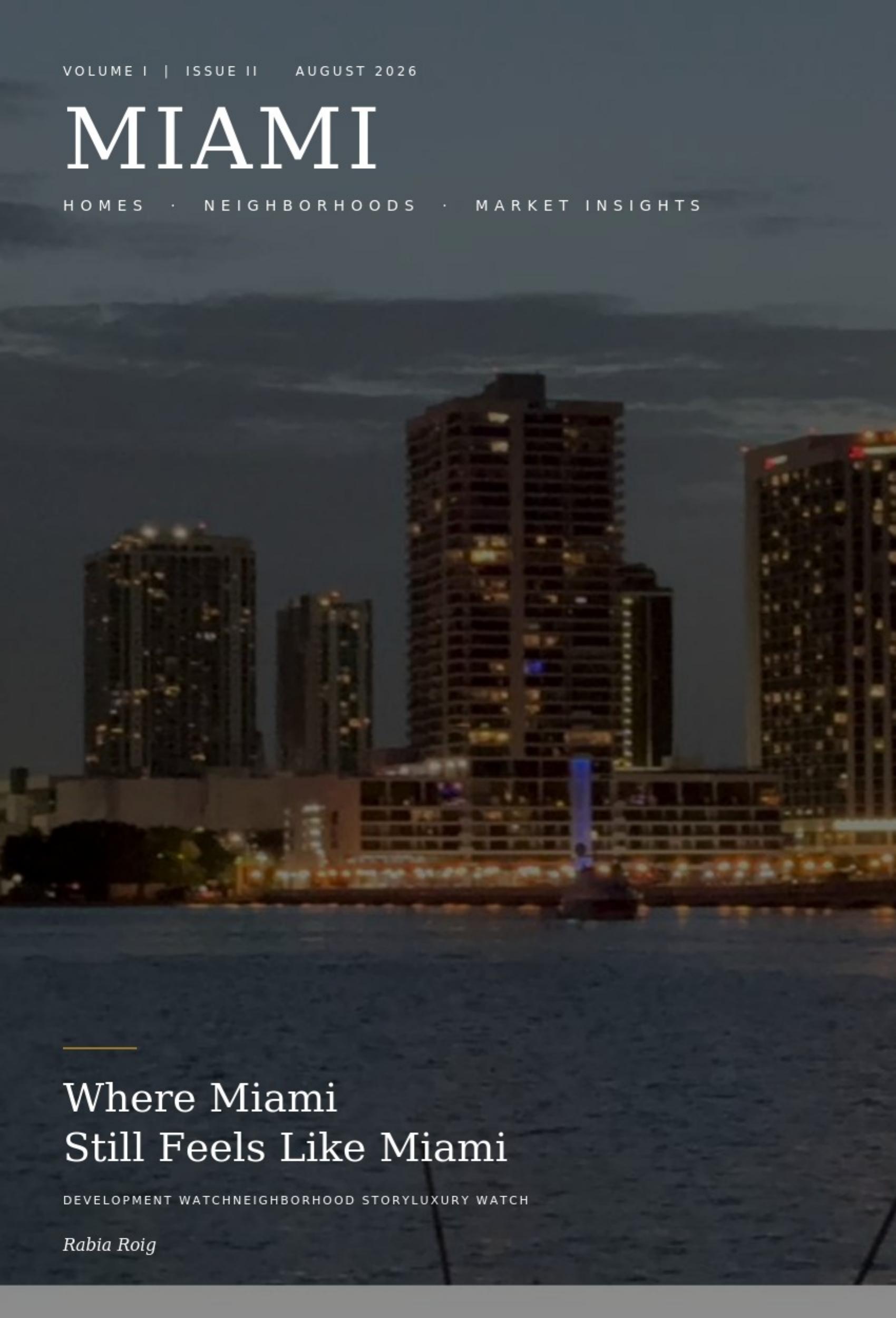



 Volume I · Issue II · August 2026
Homes · Neighborhoods · Market Insights
By Rabia Roig, Beachfront Realty
“Where Miami still feels like Miami.”
A Note from Rabia: Where Miami Still Feels Like Miami
I still remember the first time I walked under the banyan trees on Main Highway. I wasn't looking for a house that day. I was looking for something quieter than what I already knew — and Coconut Grove found me before I found it.
I've thought about that walk many times since. There's a particular kind of light that falls through those trees in the late afternoon, and it always brings me back to the small Mediterranean villages I loved growing up — the ones where nobody seemed to be rushing anywhere, where a coffee could take an hour and nobody thought that was strange.
In a city that rarely slows down, Coconut Grove still moves at that pace. It's one of the only places I know where the best places aren't just where we live — they're where we truly feel at home.
This month, that's where I'm taking you. Not just to look at real estate, but to walk the same streets I walk on a Saturday morning, sit where the locals sit, and understand why this particular corner of Miami has never gone out of style.
So whether you already know the Grove or you're only beginning to discover it… welcome. Thank you for joining me. I hope you'll enjoy discovering it as much as I still do, every time.
Market Pulse: The Market in One Minute
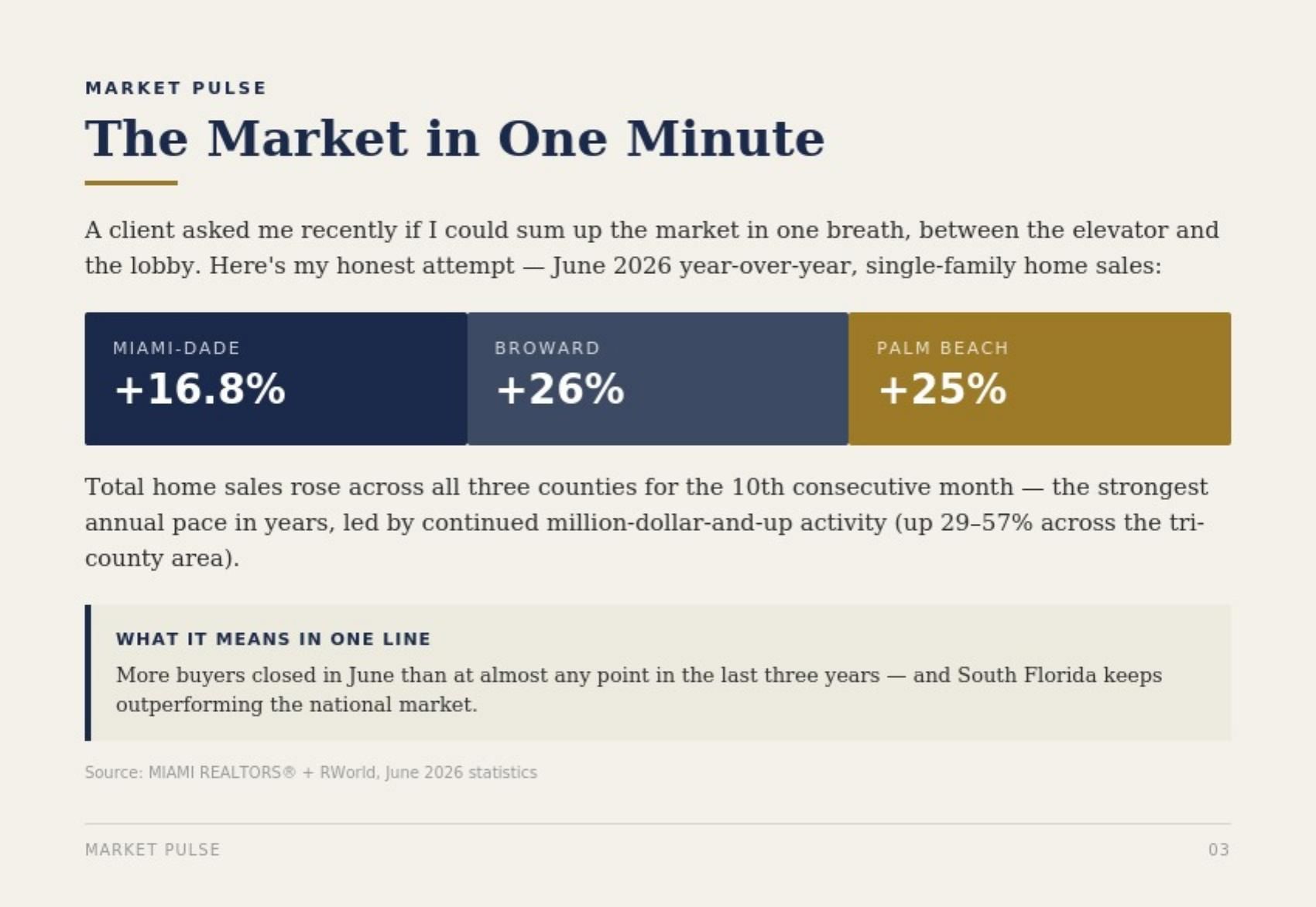
A client asked me recently if I could sum up the market in one breath, between the elevator and the lobby. Here's my honest attempt — June 2026 year-over-year, single-family home sales:
Miami-Dade +16.8% · Broward +26% · Palm Beach +25%
Total home sales rose across all three counties for the 10th consecutive month — the strongest annual pace in years, led by continued million-dollar-and-up activity (up 29–57% across the tri-county area).
What it means in one line: More buyers closed in June than at almost any point in the last three years — and South Florida keeps outperforming the national market.
Source: MIAMI REALTORS® + RWorld, June 2026 statistics
Miami-Dade — A Market Driven by Global Demand
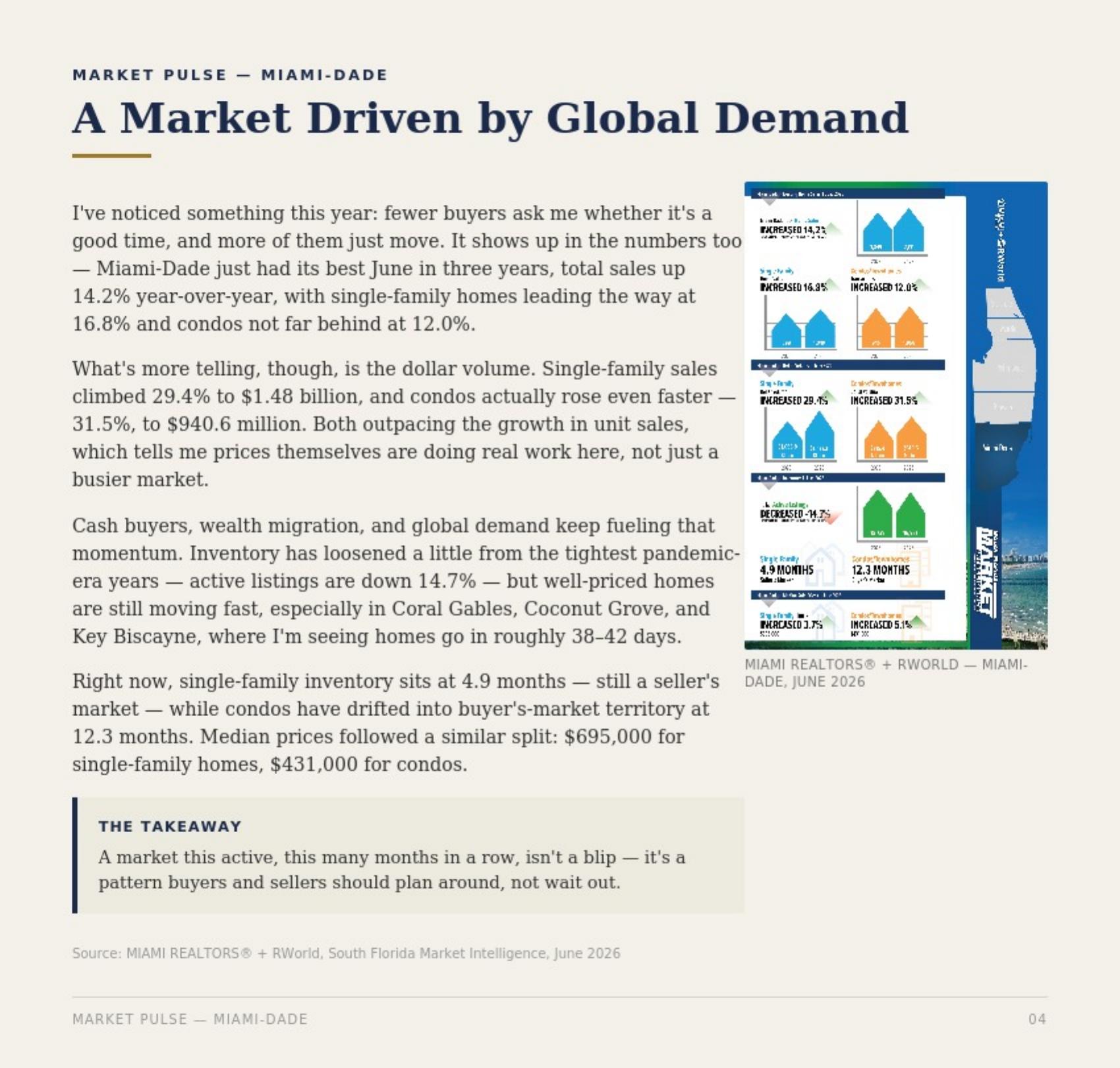
Here's a small shift I've picked up on this year: fewer buyers ask me whether it's a good time, and more of them just move. It shows up in the numbers too — Miami-Dade just had its best June in three years, total sales up 14.2% year-over-year, with single-family homes leading the way at 16.8% and condos not far behind at 12.0%.
What's more telling, though, is the dollar volume. Single-family sales climbed 29.4% to $1.48 billion, and condos actually rose even faster — 31.5%, to $940.6 million. Both outpacing the growth in unit sales, which tells me prices themselves are doing real work here, not just a busier market.
Cash buyers, wealth migration, and global demand keep fueling that momentum. Inventory has loosened a little from the tightest pandemic-era years — active listings are down 14.7% — but well-priced homes are still moving fast, especially in Coral Gables, Coconut Grove, and Key Biscayne, where I'm seeing homes go in roughly 38–42 days.
Right now, single-family inventory sits at 4.9 months — still a seller's market — while condos have drifted into buyer's-market territory at 12.3 months. Median prices followed a similar split: $695,000 for single-family homes, $431,000 for condos.
The takeaway: A market this active, this many months in a row, isn't a blip — it's a pattern buyers and sellers should plan around, not wait out.
Source: MIAMI REALTORS® + RWorld, South Florida Market Intelligence, June 2026
Broward — Opportunity Meets Momentum
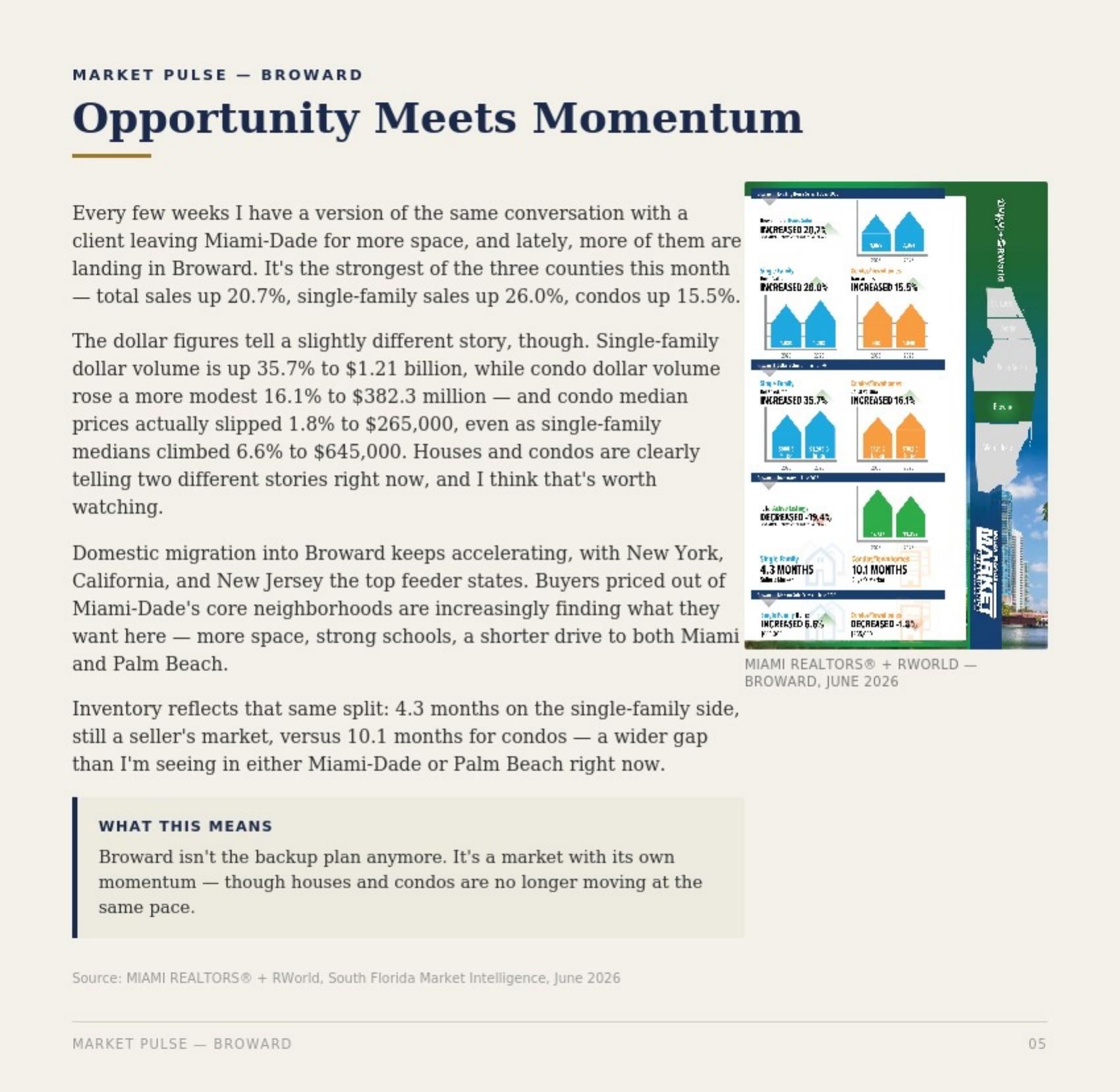
Every few weeks I have a version of the same conversation with a client leaving Miami-Dade for more space, and lately, more of them are landing in Broward. It's the strongest of the three counties this month — total sales up 20.7%, single-family sales up 26.0%, condos up 15.5%.
The dollar figures tell a slightly different story, though. Single-family dollar volume is up 35.7% to $1.21 billion, while condo dollar volume rose a more modest 16.1% to $382.3 million — and condo median prices actually slipped 1.8% to $265,000, even as single-family medians climbed 6.6% to $645,000. Houses and condos are clearly telling two different stories right now, and I think that's worth watching.
Domestic migration into Broward keeps accelerating, with New York, California, and New Jersey the top feeder states. Buyers priced out of Miami-Dade's core neighborhoods are increasingly finding what they want here — more space, strong schools, a shorter drive to both Miami and Palm Beach.
Inventory reflects that same split: 4.3 months on the single-family side, still a seller's market, versus 10.1 months for condos — a wider gap than I'm seeing in either Miami-Dade or Palm Beach right now.
What this means: Broward isn't the backup plan anymore. It's a market with its own momentum — though houses and condos are no longer moving at the same pace.
Source: MIAMI REALTORS® + RWorld, South Florida Market Intelligence, June 2026
Palm Beach — Steady Growth, Record Confidence
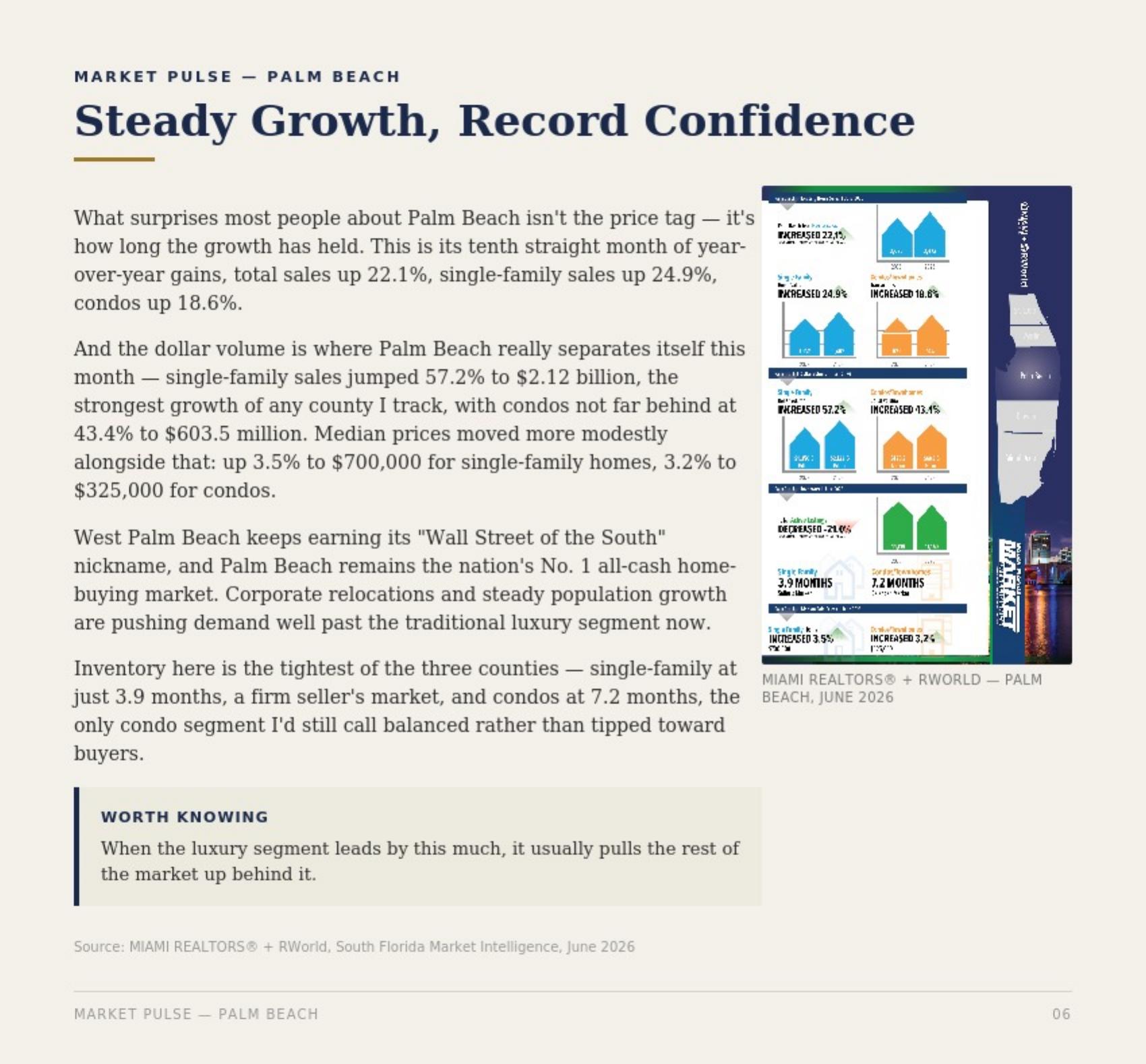
What surprises most people about Palm Beach isn't the price tag — it's how long the growth has held. This is its tenth straight month of year-over-year gains, total sales up 22.1%, single-family sales up 24.9%, condos up 18.6%.
And the dollar volume is where Palm Beach really separates itself this month — single-family sales jumped 57.2% to $2.12 billion, the strongest growth of any county I track, with condos not far behind at 43.4% to $603.5 million. Median prices moved more modestly alongside that: up 3.5% to $700,000 for single-family homes, 3.2% to $325,000 for condos.
West Palm Beach keeps earning its “Wall Street of the South” nickname, and Palm Beach remains the nation's No. 1 all-cash home-buying market. Corporate relocations and steady population growth are pushing demand well past the traditional luxury segment now.
Inventory here is the tightest of the three counties — single-family at just 3.9 months, a firm seller's market, and condos at 7.2 months, the only condo segment I'd still call balanced rather than tipped toward buyers.
Worth knowing: When the luxury segment leads by this much, it usually pulls the rest of the market up behind it.
Source: MIAMI REALTORS® + RWorld, South Florida Market Intelligence, June 2026
What These Numbers Mean
Every few weeks I hear some version of the same three questions, from three different kinds of people. Here's what I actually tell them.
For Buyers. Inventory is easing in some segments, but well-priced homes in desirable neighborhoods are still moving in under six weeks. Waiting for a dramatically softer market isn't supported by ten straight months of growth.
For Sellers. Presentation and realistic pricing matter more than they did two years ago. Buyers have more comparison points now — homes priced to the current market, not last year's, sell fastest.
For Investors. The million-dollar-and-above segment is outperforming across all three counties (+29% to +57%). That's not a niche trend anymore — it's where a meaningful share of this year's growth is coming from.
Hurricane Season & Insurance: The Best Insurance Market in Years
— with a few things still worth checking
One thing I've noticed lately: clients who braced themselves for another brutal insurance renewal are calling me back surprised. Florida's property insurance market is in its healthiest stretch in years. Citizens Property Insurance is implementing an average statewide rate reduction, with even larger drops in Miami-Dade (~13.9%) and Broward (~14.1%). Reinsurance costs are down 15–20% at recent renewals, and more than 30 private carriers are now actively writing Florida business.
None of this means hurricane season stops mattering. A few things I always walk buyers and sellers through this time of year:
Roof age — many carriers still price roofs over 15 years old very differently. Flood zones — standard homeowners policies exclude flood damage entirely. Inspections — a four-point or wind-mitigation inspection can meaningfully change your quote.
The bigger picture: A softer insurance market is real relief — but it rewards buyers and sellers who ask the right questions early, not the ones who assume the old, harder rules still apply.
Sources: Florida Office of Insurance Regulation; Insurance Journal, June 2026
Interest Rates: Beyond the Mortgage Rate
Someone touring a listing with me last week asked whether they should wait for rates to drop before making an offer. I told them what I tell everyone: interest rates get outsized attention. They shape the monthly payment, but they don't decide whether a neighborhood has a future.
A quick example: on a $650,000 home, the difference between a 6.5% and a 7% rate is roughly $190/month on a 30-year loan — meaningful, but rarely the difference between buying and not buying the right house.
With more inventory than a year ago in several segments, buyers have room to ask for rate buy-downs or closing cost credits again — something that was rare in 2021–2022.
Buyers: Focus less on chasing the perfect rate and more on the neighborhood you actually want to live in.
Sellers: A well-prepared, well-priced home is still finding buyers in weeks, not months.
The Psychology of Buying a Home: Why Logic Chooses the House
…but emotion usually chooses the neighborhood.
After enough years of showing homes, I've noticed something buyers rarely admit out loud: they don't actually remember the square footage of the house they almost bought. They remember the porch where they imagined drinking coffee on a Sunday morning. The street where kids were riding bicycles the moment we pulled up. A particular tree.
I still send comps. I still walk clients through price per square foot and what a new roof costs. That part of the job hasn't changed. But I've stopped being surprised when someone passes on the “better” house for one that simply felt right, in a way they couldn't quite explain and didn't feel the need to.
What surprises most people is how early that decision actually gets made — usually within the first few minutes on the street, long before anyone's discussed the kitchen. A house is four walls and a roof. A neighborhood is what your Tuesday mornings will actually feel like for the next ten years.
So these days I ask fewer questions about bedrooms than people expect. I ask what a good morning looks like for them. Where they want to be able to walk without getting in the car. That's usually where I learn more than any spreadsheet could tell me.
What I've learned: The data narrows the list. The feeling picks the winner. Good decisions need both — and most regret I've seen came from buyers who only trusted one.
Coffee with Rabia
“Some mornings I forget where I put my keys. I never forget where the good mango stand shows up on Sundays, or which neighbor waters her bougainvillea at exactly 7 a.m., rain or shine.
There's a woman two streets from my house who's been growing that bougainvillea over her fence for as long as I've lived there. We've never had a real conversation — just a wave, every single time, for years. I used to think that wasn't enough to call a friendship.
I'm not so sure anymore.
Maybe that's what I love most about this place. You don't have to know someone's whole story for them to still be part of yours.” — Rabia
Development Watch: The Places Quietly Shaping Tomorrow
I drove past a construction fence three times last month before I finally stopped to read the sign. Not every important story begins with a ribbon-cutting. Some begin exactly like that — a rezoning application, a new road, a sign announcing that something is coming.
This month, four areas caught my attention — not because they're the biggest headlines, but because together they show how differently South Florida keeps growing, county by county.
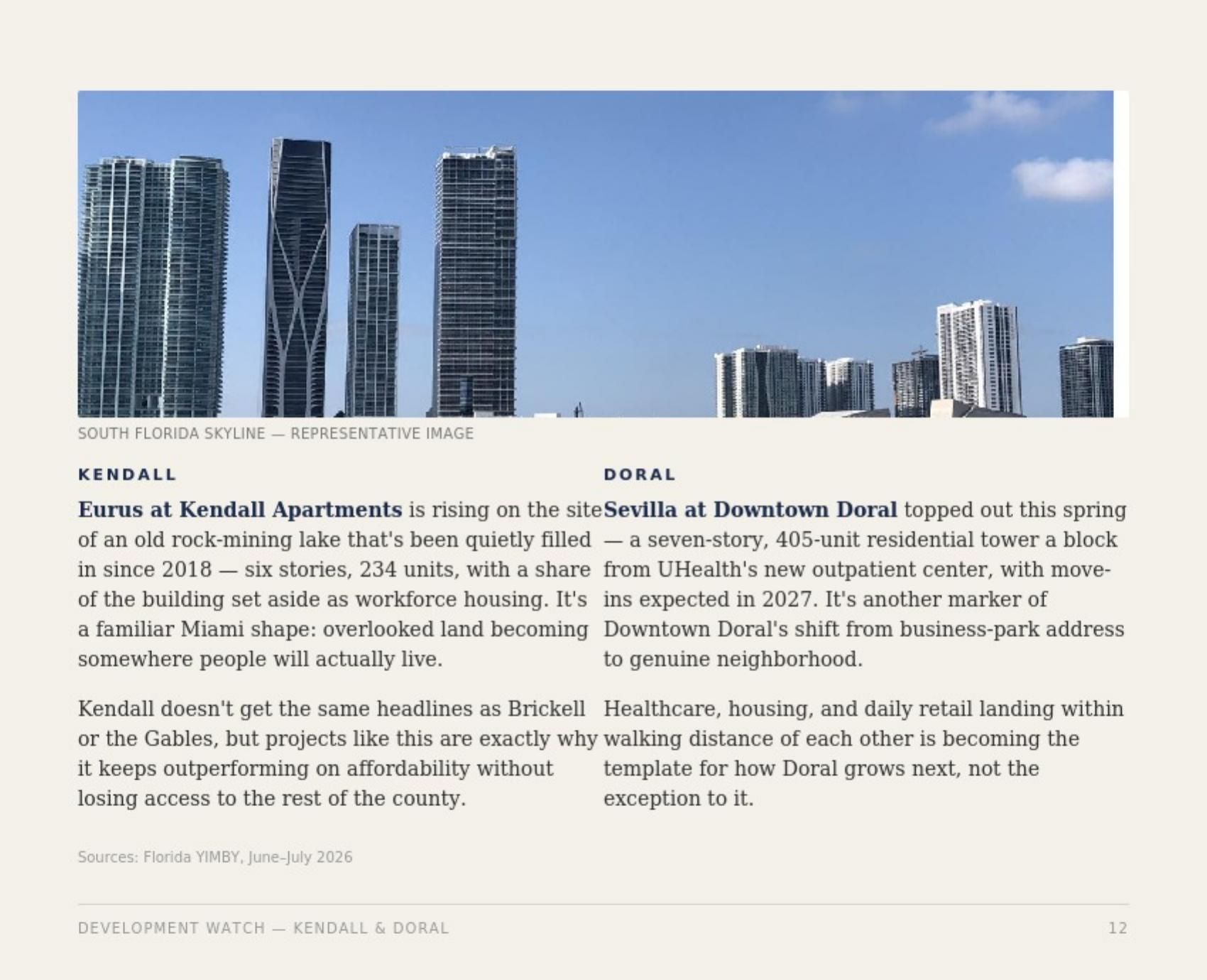
Kendall. Eurus at Kendall Apartments is rising on the site of an old rock-mining lake that's been quietly filled in since 2018 — six stories, 234 units, with a share of the building set aside as workforce housing. It's a familiar Miami shape: overlooked land becoming somewhere people will actually live.
Kendall doesn't get the same headlines as Brickell or the Gables, but projects like this are exactly why it keeps outperforming on affordability without losing access to the rest of the county.
Doral. Sevilla at Downtown Doral topped out this spring — a seven-story, 405-unit residential tower a block from UHealth's new outpatient center, with move-ins expected in 2027. It's another marker of Downtown Doral's shift from business-park address to genuine neighborhood.
Healthcare, housing, and daily retail landing within walking distance of each other is becoming the template for how Doral grows next, not the exception to it.
Sources: Florida YIMBY, June–July 2026
Homestead. Miami FC has broken ground on the Sports Performance Hub, a 15,000-seat stadium that will give Homestead its first professional soccer home — part of a wave of momentum ahead of next summer's World Cup. It's the kind of project that changes how a place sees itself long before it changes a spreadsheet.
Stadiums rarely move real estate on their own, but the roads, restaurants, and hotel rooms built around them almost always do — and Homestead is early in that curve, not late.
North Bay Village. After eighty years without a true trophy address, North Bay Village is getting one. Related Group and Macklowe Properties have unveiled The Ritz-Carlton Residences — two 43-story towers on Harbor Island, 364 condominiums, and a private marina. It's Macklowe's first ground-up project in South Florida.
A three-island village that spent decades in the shadow of Miami Beach and Bal Harbour is suddenly a Related and Macklowe address — that's not a small signal about where buyer confidence is heading next.
Hidden Miami: Two Bridges, Two Scales
Some bridges get a headline. Others get a decade of them.
This month, a modest bridge finally opened over the C-100 canal in Cutler Bay — connecting Southwest 87th Avenue between Cutler Bay and Palmetto Bay. It doesn't look like much: two lanes, a bike lane, a sidewalk. But it took years of council votes, lawsuits, and one appeals court ruling to get built, because for the families on both sides of that canal, it was never really about the bridge. It was about the six-mile detour it replaced, and the ambulance that used to have to take it.
A few miles north, a very different bridge is still rising. The “Signature Bridge” — six sculptural arches spanning NE 2nd Avenue and Biscayne Boulevard, part of the $866 million I-395/SR 836/I-95 interchange rebuild — was supposed to open in 2024. It's now targeting 2029. When it's finished, it will be one of the tallest arches in the state and a new fixture of the Miami skyline.
Why it matters: Not every piece of infrastructure that shapes a neighborhood makes the skyline. Some just make the school run five minutes shorter — and for the people who live there, that's the bigger story.
Also worth watching — Metro Express. South Miami-Dade quietly got the nation's longest all-electric Bus Rapid Transit corridor this year. Metro Express runs 20 miles along the South Dade TransitWay, from Florida City to Dadeland South Metrorail Station, with 14 air-conditioned, Wi-Fi-equipped stations and a direct connection to Metrorail — putting Brickell and downtown within reach without ever touching the Turnpike. For neighborhoods like Palmetto Bay, Cutler Bay, and Homestead, that's a commute story as much as a transit one.
Sources: Miami-Dade County; Sustainable Bus; Miami Today, 2025–2026
Rabia's Notebook: I still remember the drive around that six-mile detour, years ago, with a client who lived two streets from that canal. We joked about it at the time. Neither of us was joking the day her father needed an ambulance.
Neighborhood Spotlight — Coconut Grove: Miami's Mediterranean Spirit
Some neighborhoods become popular. Others become part of who you are. Coconut Grove has quietly been doing that for generations.
History. Coconut Grove is Miami's oldest continuously inhabited neighborhood — settled before the city around it existed. That history is still visible: coral rock buildings, century-old banyans, streets that were never gridded because the Grove came first.
Character. It doesn't try to impress you. Main Highway curves beneath a canopy of trees rather than running straight at a horizon, and on a windy afternoon you can hear the banyans before you see them — that dry, papery rustle overhead that means shade is coming.
Lifestyle. Life here moves at the pace of a Mediterranean village. Small cafés where people linger over coffee, the smell of it drifting out onto the sidewalk before you've even opened the door. Peacock Park on a Saturday morning. Dinner Key Marina at sunset, when the light turns gold on the water and every boat mast seems to catch it at once.
Hidden gems. The Kampong — a botanical garden most visitors drive past without knowing it's there. The Barnacle Historic State Park, Miami-Dade's oldest home still on its original site.
Walkability. Driving it, you see a neighborhood. Walking it, you notice the architecture, the gardens, the pace — the things that explain why people fall in love with this particular six square miles.
Buying insight: Homes here sell in roughly 38–42 days on average — one of the few Miami-Dade neighborhoods where seller's-market conditions and a genuinely walkable lifestyle coexist.
Rabia's Notebook: One of my buyers once asked me why Coconut Grove felt so different from the rest of Miami. I smiled, because that was exactly how I felt the first time I visited. Some neighborhoods don't try to impress you. Instead, they quietly make you feel like you belong.
The Hidden History of Coral Rock
The stone beneath our feet that quietly built Miami.
You've probably driven past a coral rock wall a hundred times without really seeing it. I know I did, for years — until a client stopped mid-showing to ask why some of the old walls in the Grove looked different from anything being built today. I didn't actually know the answer. So I went looking.
What I found is that Miami built with what was already here, long before concrete and steel arrived. Beneath the topsoil across much of Miami-Dade sits Miami oolite — a porous limestone formed from ancient coral reefs, which locals have called “coral rock” for well over a century.
It's the same stone behind Coconut Grove's oldest walls and their honeycombed texture, and it's not decorative — it's structural. When George Merrick set out to build Coral Gables in the 1920s, he hired Bahamian stonemasons, many from Coconut Grove's own Charles Avenue community, whose families had been cutting and setting coral rock since arriving from Eleuthera in the 1880s. Their skill is the reason Coral Gables' entrances, walls, and early homes still stand exactly as they were laid a century ago.
The Biltmore Hotel, Vizcaya's garden walls, the coral rock houses that still line parts of the historic West Grove — all of it came out of the same quarries, cut and set largely by hand. Old Cutler Road's low coral rock walls, planted alongside the banyans, are from that same era and that same craft.
Now I can't drive down that road without pointing it out to whoever's in the car with me, whether they asked or not. What looks like landscaping is actually a building material older than the city itself, laid by a workforce whose names rarely made it into the history books — though their work is still holding up some of Miami's most valuable addresses.
Why it matters: Some of Miami-Dade's most desirable historic properties are valuable in part because of a material and a craft that can't be replicated with a permit and a concrete truck. That's part of what buyers are actually paying for.
Sources: HistoricPreservationMiami.com; Little Bahamas Miami; City of Miami historic designation records
Around Town: If You Gave Me One Free Morning in the Grove
…this is exactly where I'd take you.
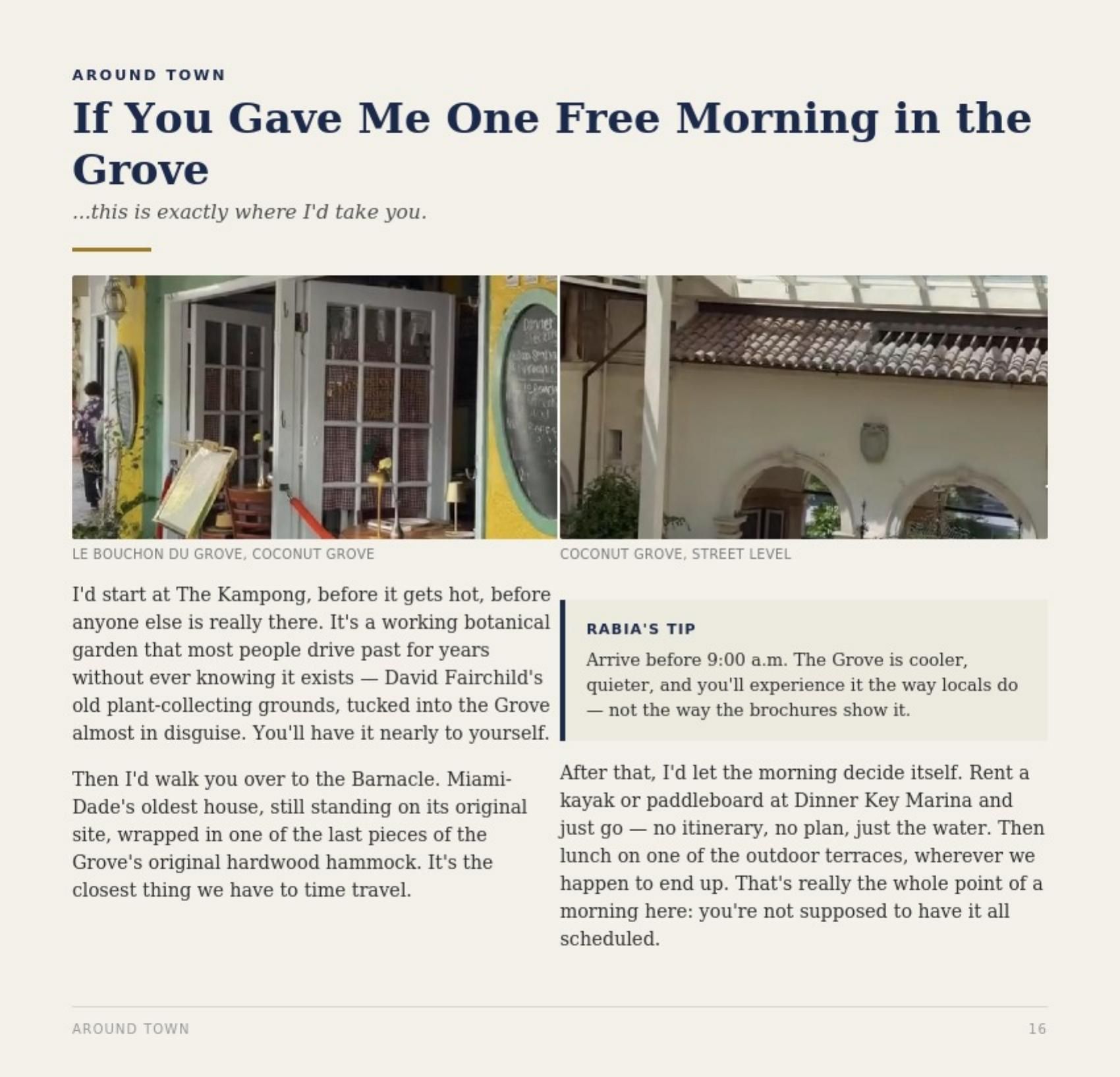
I'd start at The Kampong, before it gets hot, before anyone else is really there. It's a working botanical garden that most people drive past for years without ever knowing it exists — David Fairchild's old plant-collecting grounds, tucked into the Grove almost in disguise. You'll have it nearly to yourself.
Then I'd walk you over to the Barnacle. Miami-Dade's oldest house, still standing on its original site, wrapped in one of the last pieces of the Grove's original hardwood hammock. It's the closest thing we have to time travel.
Rabia's tip: Arrive before 9:00 a.m. The Grove is cooler, quieter, and you'll experience it the way locals do — not the way the brochures show it.
After that, I'd let the morning decide itself. Rent a kayak or paddleboard at Dinner Key Marina and just go — no itinerary, no plan, just the water. Then lunch on one of the outdoor terraces, wherever we happen to end up. That's really the whole point of a morning here: you're not supposed to have it all scheduled.
Luxury Watch: Luxury Has Never Been About Size
People often ask me what makes a home luxurious.
They expect me to talk about marble kitchens, waterfront views, soaring ceilings, or impressive square footage. Those things certainly have their place, and I appreciate beautiful design as much as anyone.
But after living in different countries and walking through homes across different cultures, I've come to believe that true luxury is much quieter.
It's the way morning light fills a room before the city wakes. It's the sound of water when you open a terrace door. It's a centuries-old tree that gives shade to a garden every afternoon. It's the craftsmanship of a staircase built to last for generations, or the feeling of sitting on a balcony where time seems to slow down.
Perhaps that's why I always find myself drawn to places like Vizcaya, or the quiet streets of Coconut Grove. They remind me that elegance isn't something you decorate a home with. It's something you feel long before you've noticed the furniture.
The most memorable homes I've visited were not always the largest. Some were surprisingly modest. Yet they possessed something impossible to measure on a listing sheet: character, a sense of place, and a harmony between architecture, light, nature, and the people who lived there.
In South Florida, luxury is evolving. Buyers still appreciate exceptional finishes, but more and more they are searching for something deeper: walkable neighborhoods, mature trees, beautiful proportions, privacy, authenticity, and a home that feels connected to its surroundings rather than separated from them.
Perhaps that's why Mediterranean architecture has always spoken to me. Growing up between cultures, I've always been drawn to places where life naturally unfolds outdoors — where terraces become living rooms, gardens become gathering places, and beauty is found as much in simplicity as in grandeur.
To me, luxury has never been about owning the biggest house.
It has always been about finding the place where you instantly feel at home.
Bottom line: Luxury isn't measured by square footage or price alone. It's measured by how a place makes you slow down, breathe a little deeper, and quietly think: I could see myself living here.
Lifestyle: South Florida in August
One thing I've noticed about South Florida in August: everyone complains about the heat, and then shows up to every outdoor event anyway. Here's what caught my eye this month.
Events. Jamaica Independence Festival, Wynwood Marketplace (Aug 2). Wynwood Art Walk (Aug 8) — free, second Saturday. PAMM Free Second Saturdays (Aug 8) — free admission, family art-making all day.
Food & Drink. Miami Spice Restaurant Months (Aug 1 – Sep 30), its 25th anniversary year. Three-course prix-fixe menus at over 100 restaurants, from $40 lunch to $65 dinner.
Outdoor. Coconut Grove Organic Farmers Market, Glaser Farms — Saturdays. Palmetto Bay Artisan & Farmers Market, Coral Reef Park — Sundays. Vizcaya Village Farmers Market — Sundays.
Rabia's Calendar: If I could only recommend one August morning — Palmetto Bay's Sunday market, then a slow drive home with the windows down.
Weekend Escape: Key Biscayne & Bill Baggs Cape Florida
Less than 30 minutes from downtown, and it feels like a different state.
Cross the Rickenbacker Causeway and the city noise drops away almost immediately — sailboats instead of traffic, mangroves instead of billboards. Key Biscayne has always been the escape Miami didn't have to leave town to find.
At the southern tip sits Bill Baggs Cape Florida State Park: a mile of uncrowded beach, one of the oldest brick lighthouses in Florida still standing from 1825, and a shaded picnic grove that makes it easy to lose an entire afternoon without a plan.
Climb the lighthouse on a clear day and the view is worth the stairs — Stiltsville's stilt houses out on the flats, the Miami skyline behind you, and Cape Florida Channel in between. It's one of the few spots where you can watch the city from just far enough away to actually see all of it.
Rabia's Tip: Go on a weekday morning if you can. Rent a bike at the park entrance, ride the full loop out to the lighthouse, and save the beach for last — you'll have most of it to yourself.
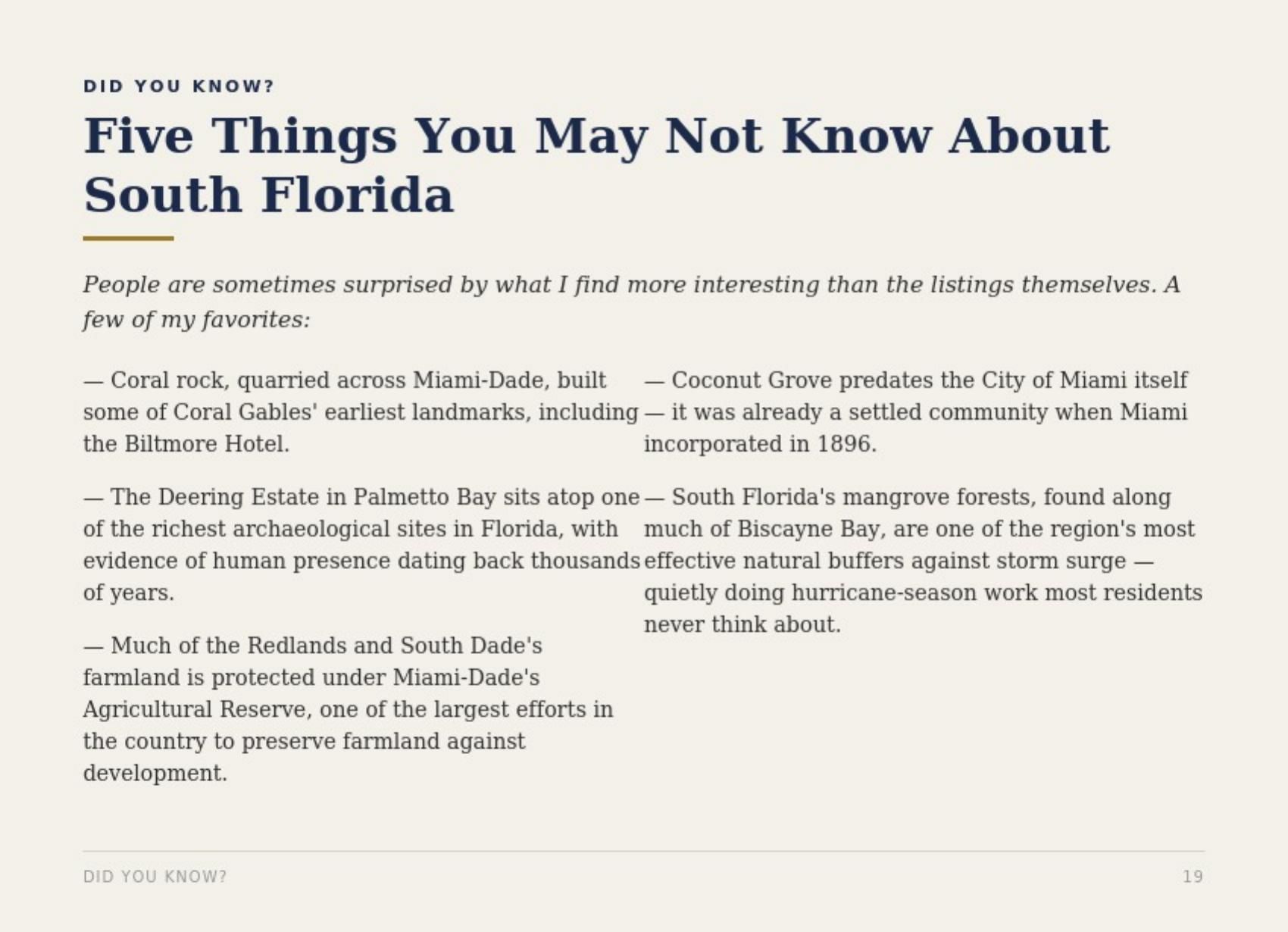
Did You Know? Five Things You May Not Know About South Florida
People are sometimes surprised by what I find more interesting than the listings themselves. A few of my favorites:
- Coral rock, quarried across Miami-Dade, built some of Coral Gables' earliest landmarks, including the Biltmore Hotel.
- The Deering Estate in Palmetto Bay sits atop one of the richest archaeological sites in Florida, with evidence of human presence dating back thousands of years.
- Much of the Redlands and South Dade's farmland is protected under Miami-Dade's Agricultural Reserve, one of the largest efforts in the country to preserve farmland against development.
- Coconut Grove predates the City of Miami itself — it was already a settled community when Miami incorporated in 1896.
- South Florida's mangrove forests, found along much of Biscayne Bay, are one of the region's most effective natural buffers against storm surge — quietly doing hurricane-season work most residents never think about.
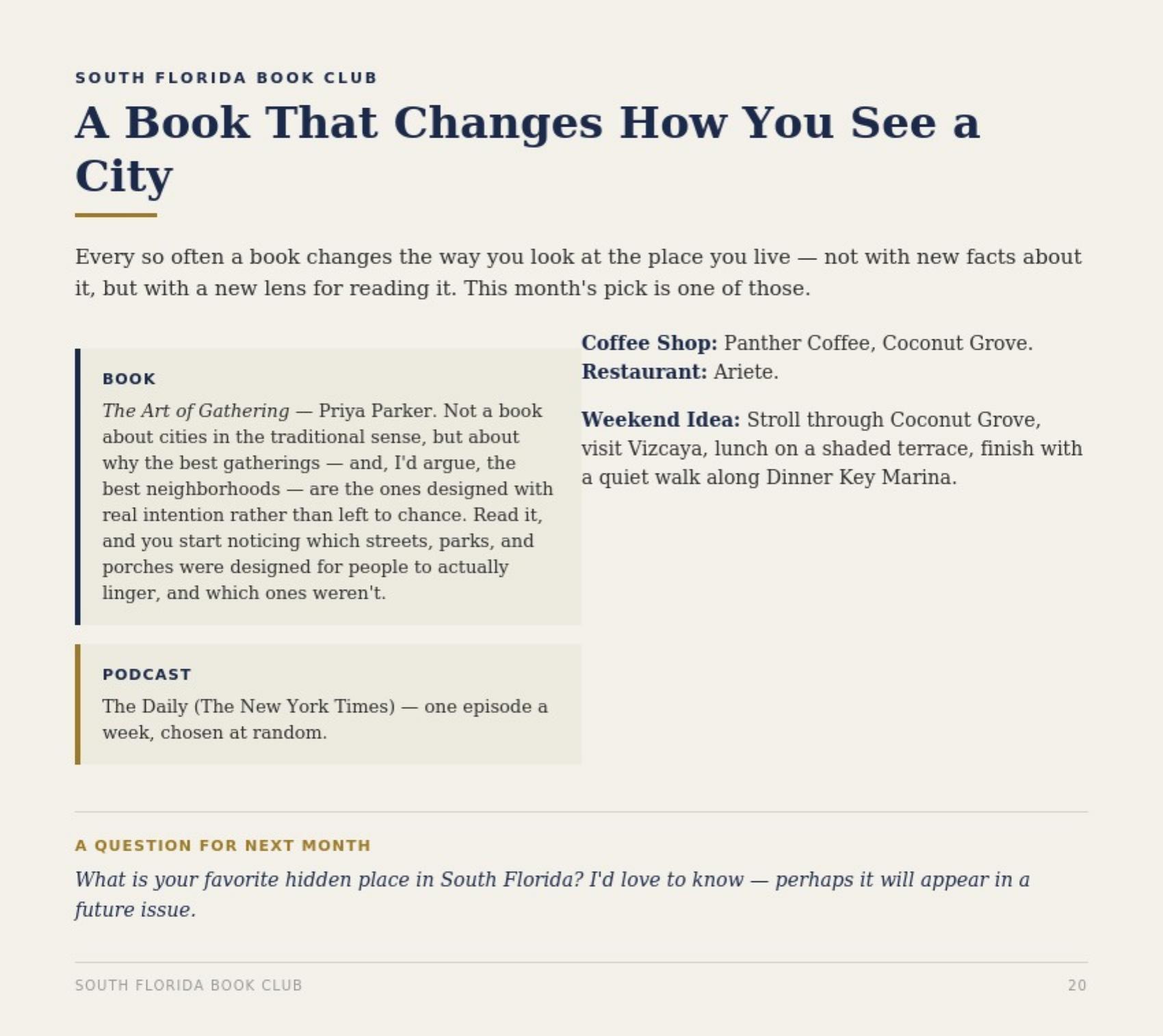
South Florida Book Club: A Book That Changes How You See a City
Every so often a book changes the way you look at the place you live — not with new facts about it, but with a new lens for reading it. This month's pick is one of those.
Book: The Art of Gathering — Priya Parker. Not a book about cities in the traditional sense, but about why the best gatherings — and, I'd argue, the best neighborhoods — are the ones designed with real intention. Read it, and you start noticing which streets, parks, and porches were designed for people to linger, and which weren't.
Podcast: The Daily (The New York Times) — one episode a week, chosen at random.
Coffee Shop: Panther Coffee, Coconut Grove. Restaurant: Ariete.
Weekend Idea: Stroll through Coconut Grove, visit Vizcaya, lunch on a shaded terrace, finish with a quiet walk along Dinner Key Marina.
A question for next month: What is your favorite hidden place in South Florida? I'd love to know — perhaps it will appear in a future issue.
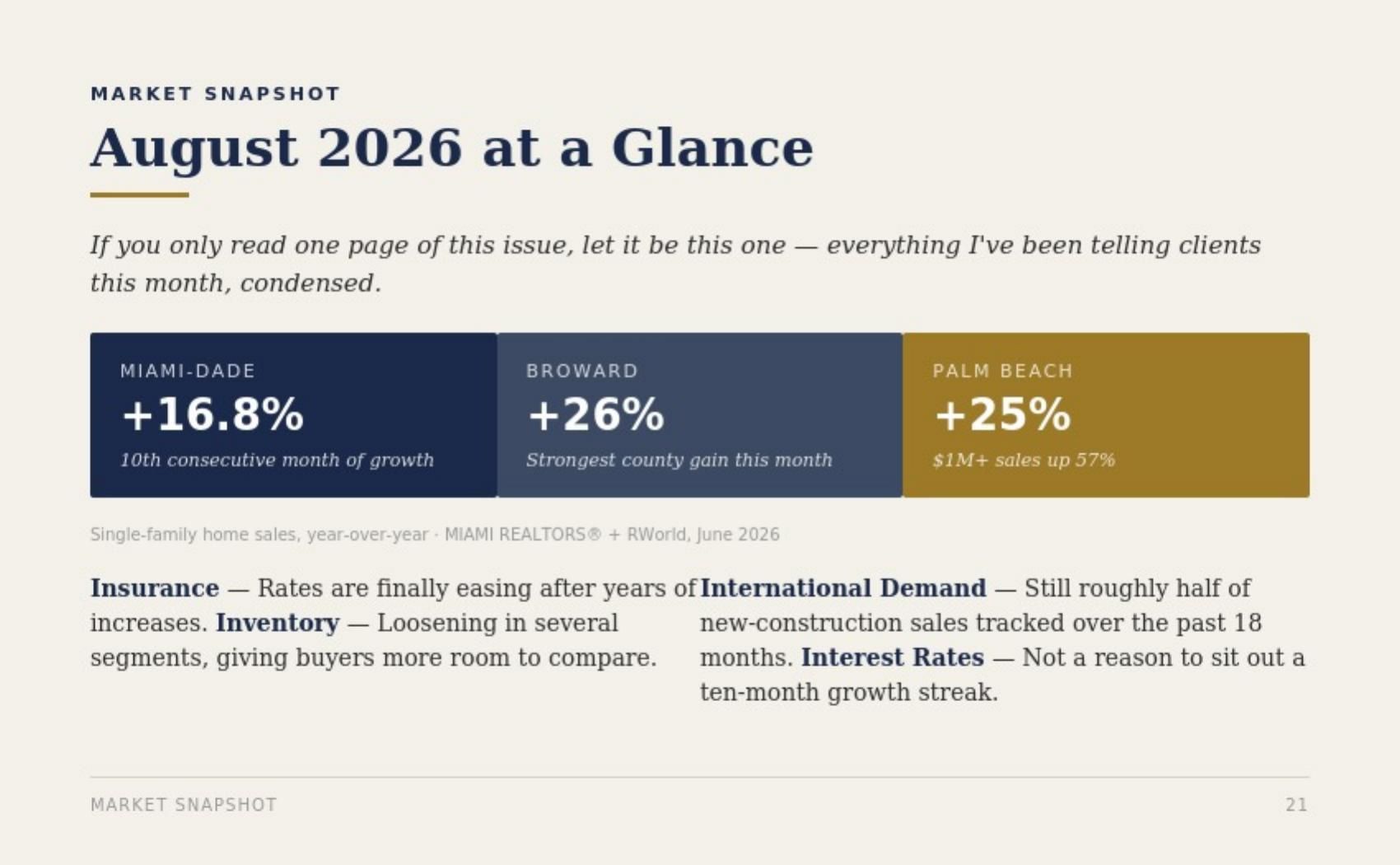
Market Snapshot: August 2026 at a Glance
If you only read one page of this issue, let it be this one — everything I've been telling clients this month, condensed.
Miami-Dade +16.8% (10th consecutive month of growth) · Broward +26% (strongest county gain this month) · Palm Beach +25% ($1M+ sales up 57%)
Single-family home sales, year-over-year · MIAMI REALTORS® + RWorld, June 2026
Insurance — Rates are finally easing after years of increases. Inventory — Loosening in several segments, giving buyers more room to compare. International Demand — Still roughly half of new-construction sales tracked over the past 18 months. Interest Rates — Not a reason to sit out a ten-month growth streak.
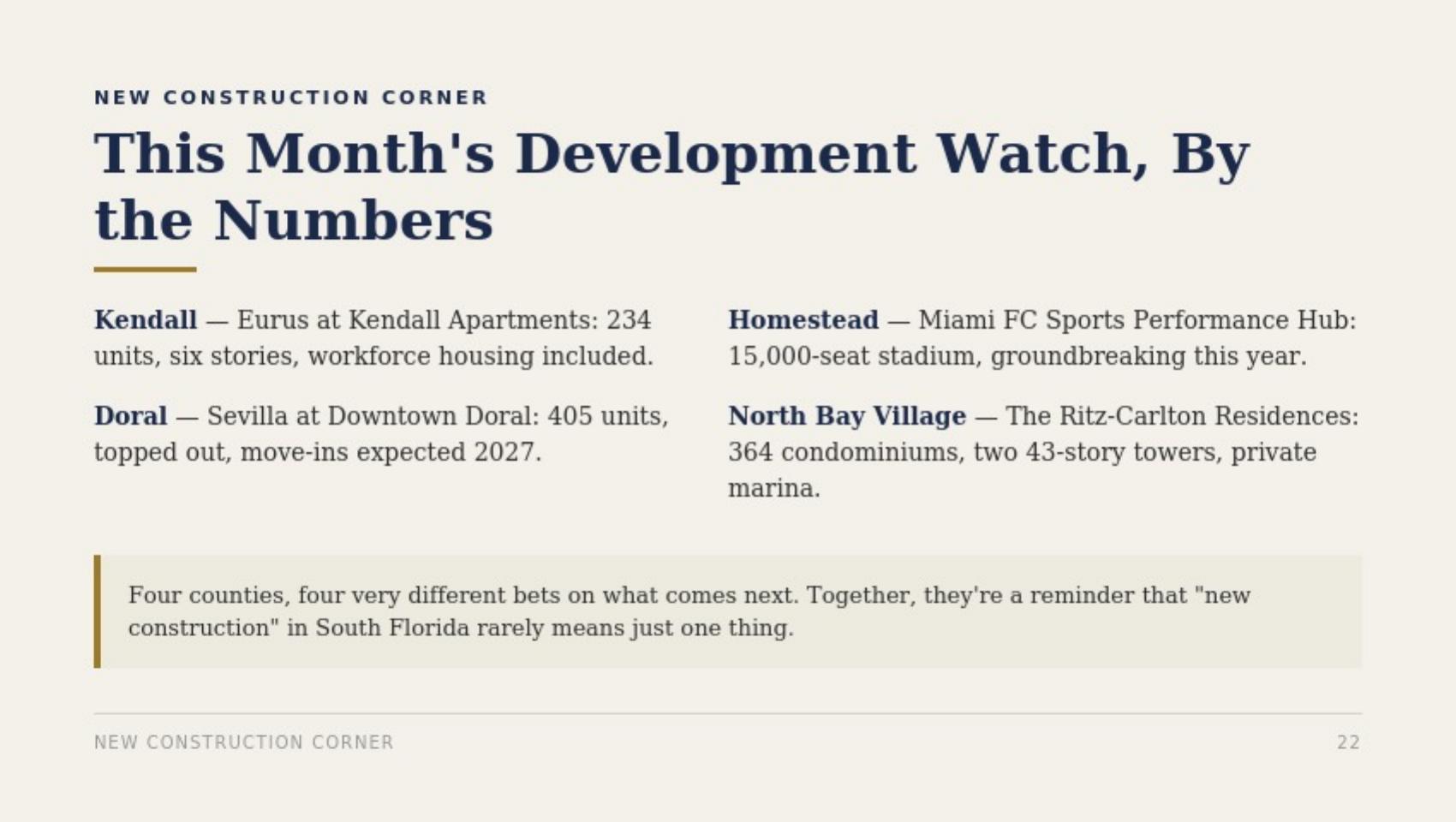
New Construction Corner: This Month's Development Watch, By the Numbers
Kendall — Eurus at Kendall Apartments: 234 units, six stories, workforce housing included.
Doral — Sevilla at Downtown Doral: 405 units, topped out, move-ins expected 2027.
Homestead — Miami FC Sports Performance Hub: 15,000-seat stadium, groundbreaking this year.
North Bay Village — The Ritz-Carlton Residences: 364 condominiums, two 43-story towers, private marina.
Four counties, four very different bets on what comes next. Together, they're a reminder that “new construction” in South Florida rarely means just one thing.
One Last Thought
Every month I visit new neighborhoods, meet new people, and open new doors. Yet one thing never changes: real estate is about more than homes. It's about finding the place where your life feels right.
Thank you for spending a little time with me this month. I'll see you again in September.
— Rabia
Next Month — September 2026: Inside the Next Issue
Coral Gables: its architecture, its hidden corners, its history, and what continues to make it one of South Florida's most timeless neighborhoods.
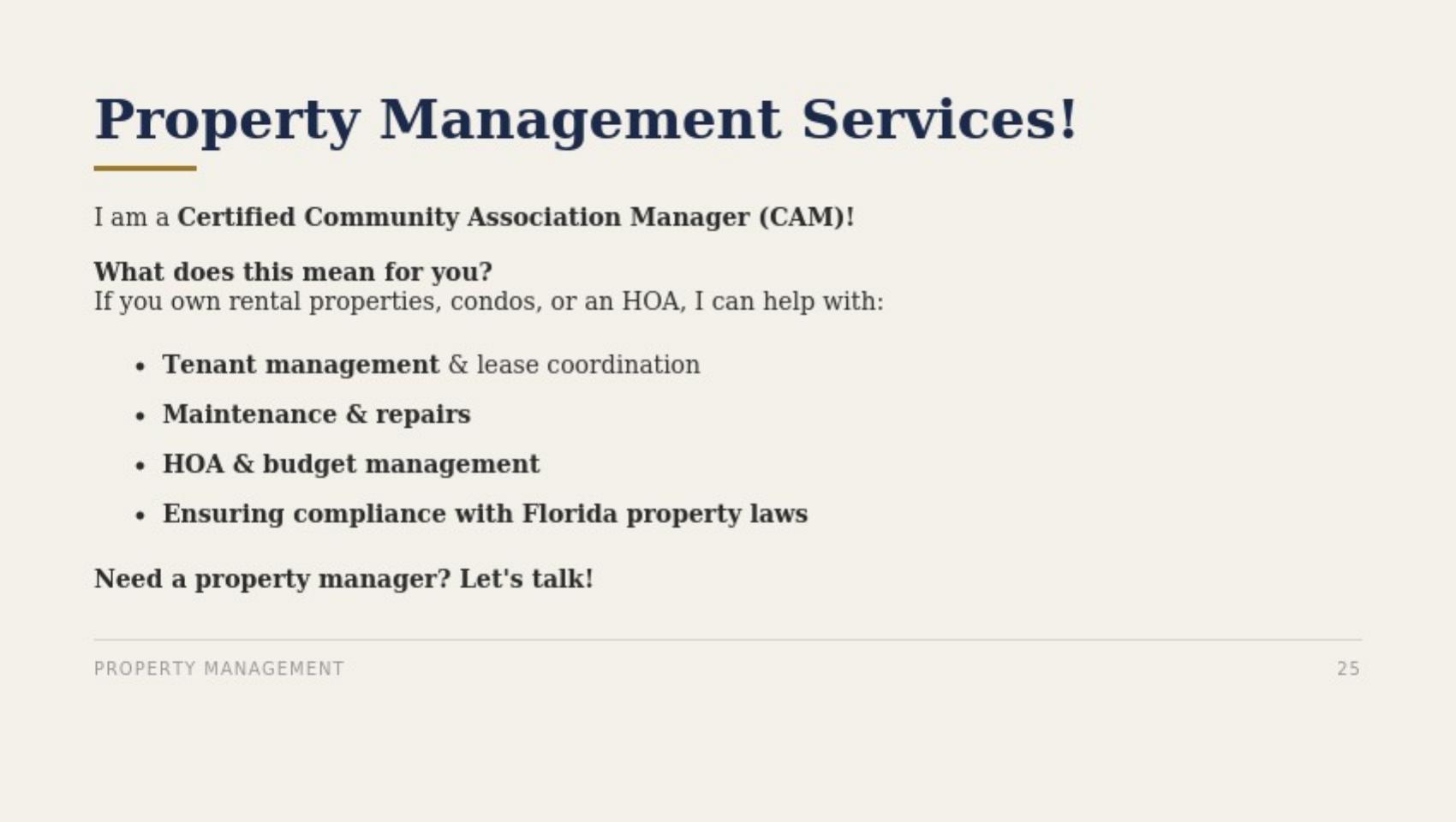
Property Management Services!
I am a Certified Community Association Manager (CAM)! What does this mean for you? If you own rental properties, condos, or an HOA, I can help with:
- Tenant management & lease coordination
- Maintenance & repairs
- HOA & budget management
- Ensuring compliance with Florida property laws
Need a property manager? Let's talk!
Thank you for reading, sharing, asking thoughtful questions, and trusting me as your resource. Miami continues to evolve — and navigating it well requires perspective, patience, and good information.
Here's to a grounded, inspired, and opportunity-filled second half of 2026.
With appreciation and warmth,
Let's Stay in Touch
As we enter this part of the year, it's a great time to pause, refocus, and realign your goals. While headlines can sometimes create confusion, South Florida remains full of movement and opportunities — especially in specific neighborhoods and property types that continue to outperform.
Whether you're planning your next step or simply staying informed, I'm here to help you navigate this market with clarity and confidence.
Need a personalized market update or a home valuation? I'll gladly prepare one for you — just ask!
Follow me for listings, behind-the-scenes, and live market updates: LinkedIn / Facebook / Instagram / Website · 305-484-4367 · onshorerealty@gmail.com
Rabia Mohad Ep Roig — Your Dedicated Team: We Speak English, French, Spanish & Arabic
As Certified International Property Specialists (CIPS), we collaborate with real estate professionals worldwide — from North, Central, and South America to the Caribbean, Europe (including France, Spain, Italy), Asia (notably Dubai and India), and Africa (especially Morocco and Nigeria). This network enables us to assist clients in navigating cross-border investments with trusted local experts, ensuring seamless transactions and valuable insights across global markets. Whether you're considering Miami as a new investment or a second home abroad, I have the network to make it a reality.
Contact
305-484-4367 · onshorerealty@gmail.com
rabiaroig.mybeachfrontrealty.com
Categories
- All Blogs (22)
- Buying & Investment Guides (2)
- Coral gables (1)
- FLORIDA (5)
- foreign investment (1)
- Fort Lauderdale (1)
- Globalconflict (1)
- HISTORY (4)
- Homestead Florida (1)
- HUMOUR (1)
- INFO (5)
- investment (5)
- KEY BISCAYNE (1)
- Lifestyle & Culture (3)
- Lifestyle real estate (3)
- Market Intelligence (12)
- Miami (6)
- Miami-Dade Communities South Miami (2)
- Neighborhoods & Local Guides (10)
- REALESTATE (10)
- south Florida Neighborhoods (2)
- Things to do in Homestead (1)
- TOURISM (4)
Recent Posts

