
Miami Real Estate Magazine — September 2026 (Vol. 1, Issue 3)
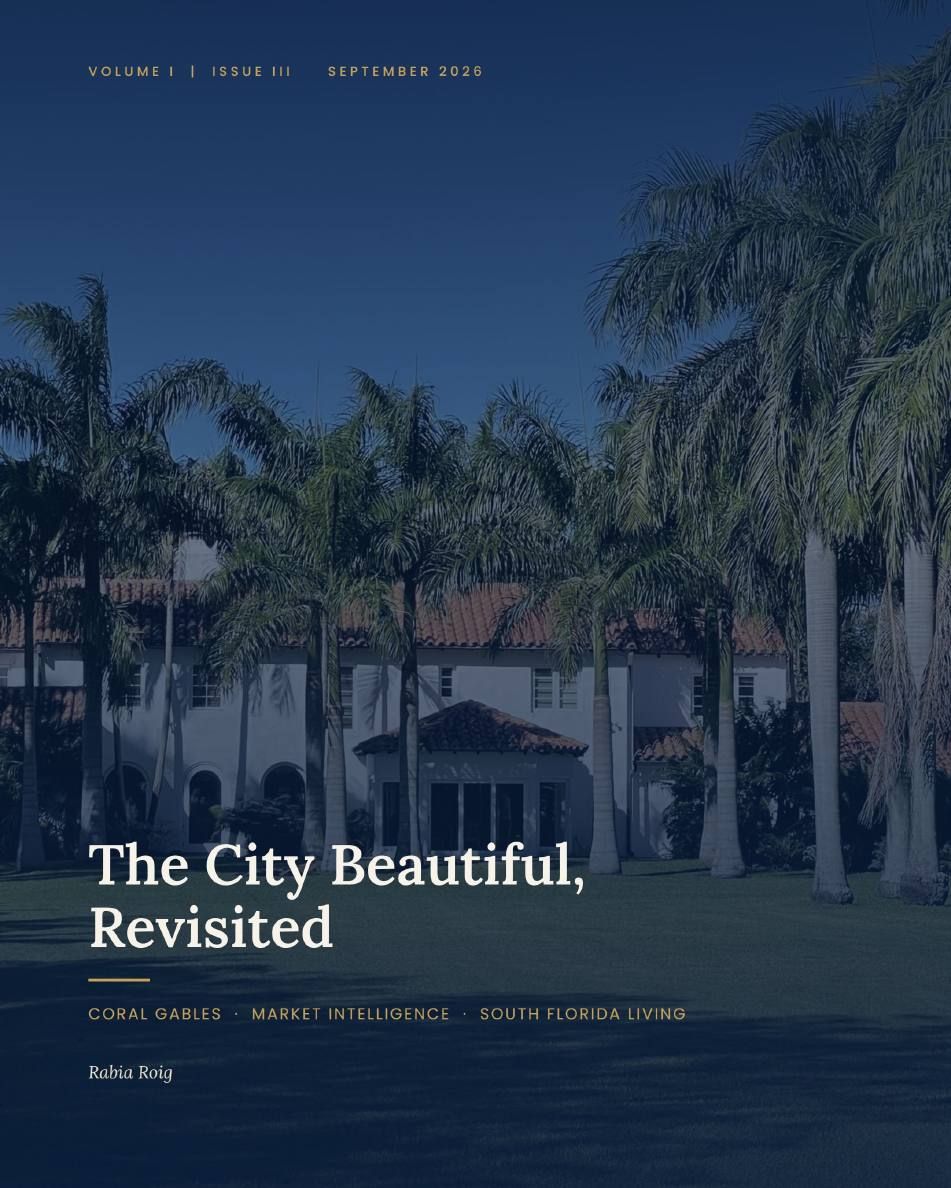 “The City Beautiful, Revisited”
Coral Gables · Market Intelligence · South Florida Living
By Rabia Mohad ep Roig, Beachfront Realty | September 2026
“The City Beautiful, Revisited.”
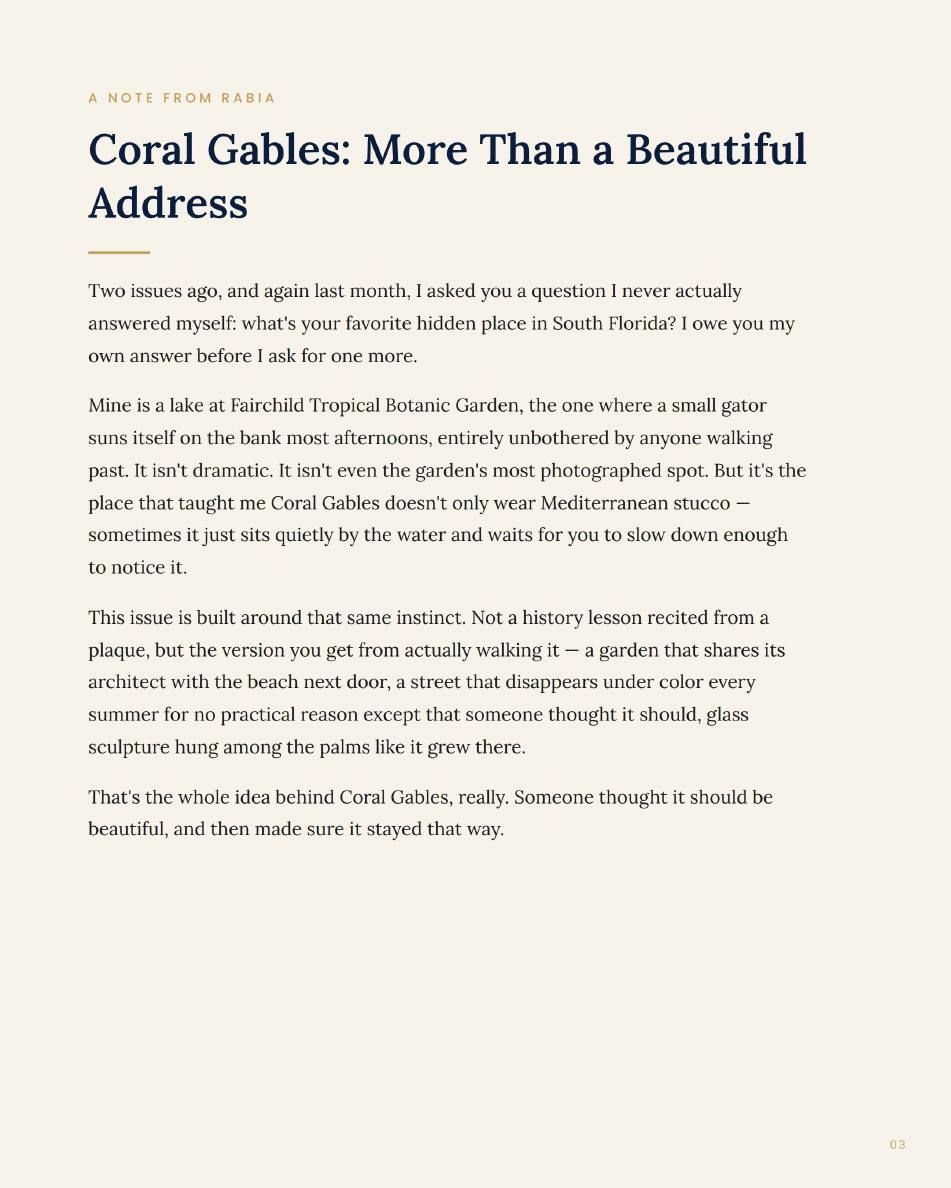
A Note from Rabia: Coral Gables — More Than a Beautiful Address
Two issues ago, and again last month, I asked you a question I never actually answered myself: what's your favorite hidden place in South Florida? I owe you my own answer before I ask for one more.
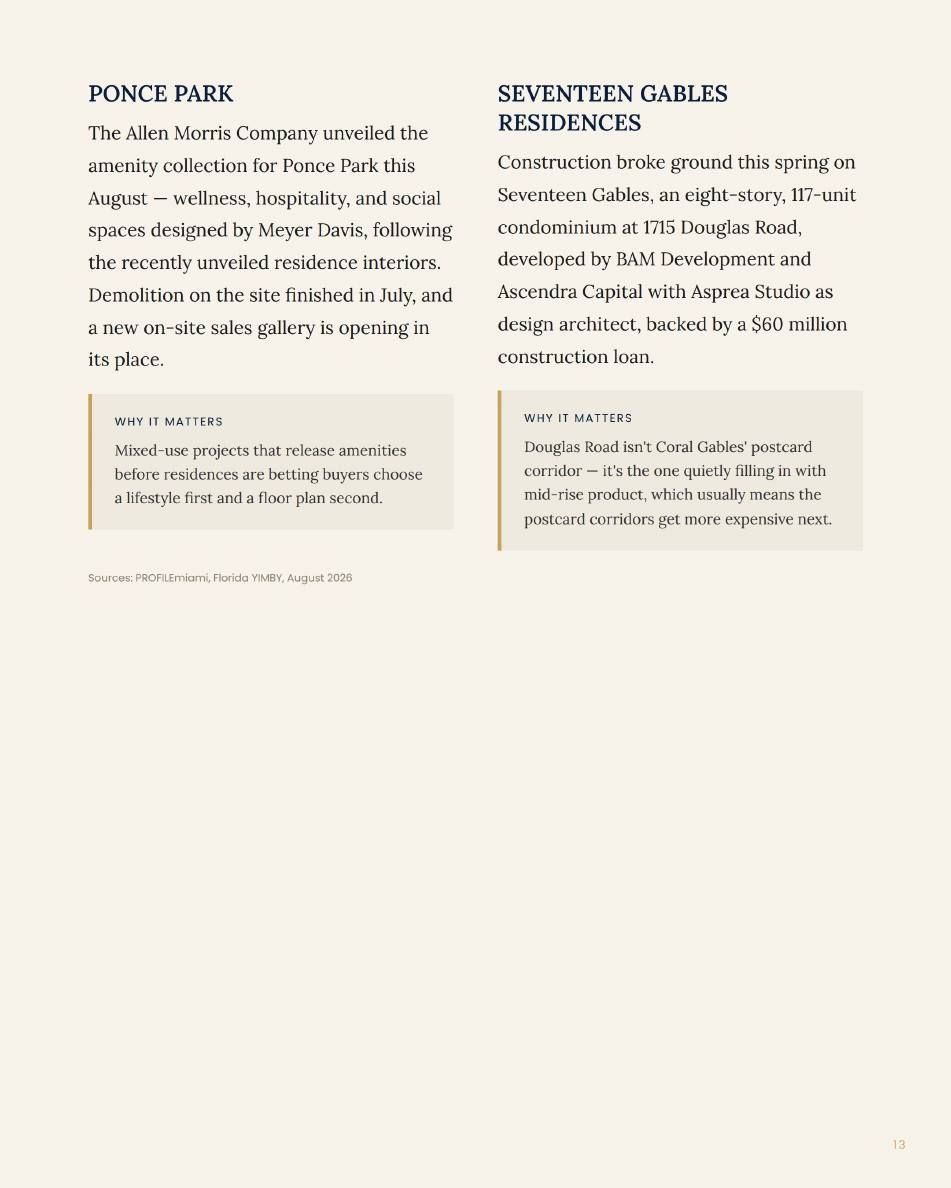
Mine is a lake at Fairchild Tropical Botanic Garden, the one where a small gator suns itself on the bank most afternoons, entirely unbothered by anyone walking past. It isn't dramatic. It isn't even the garden's most photographed spot. But it's the place that taught me Coral Gables doesn't only wear Mediterranean stucco — sometimes it just sits quietly by the water and waits for you to slow down enough to notice it.
This issue is built around that same instinct. Not a history lesson recited from a plaque, but the version you get from actually walking it — a garden that shares its architect with the beach next door, a street that disappears under color every summer for no practical reason except that someone thought it should, glass sculpture hung among the palms like it grew there.
That's the whole idea behind Coral Gables, really. Someone thought it should be beautiful, and then made sure it stayed that way.
Market Pulse: The Market in One Minute
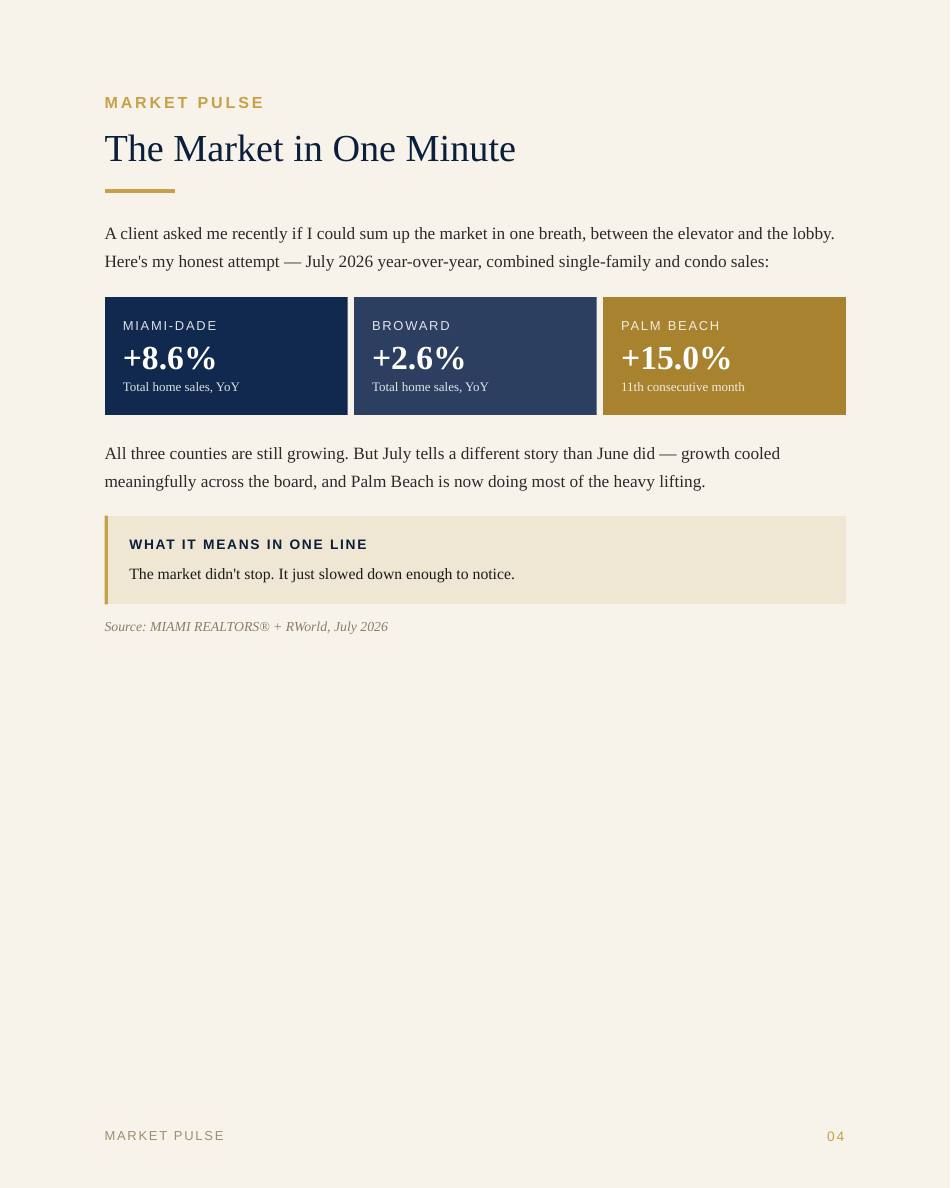
Someone in an elevator asked me last week if I could sum up the market before we reached the lobby. Here's my honest attempt — July 2026 year-over-year, combined single-family and condo sales:
Miami-Dade +8.6% (total home sales, YoY) · Broward +2.6% (total home sales, YoY) · Palm Beach +15.0% (11th consecutive month)
All three counties are still growing. But July tells a different story than June did — growth cooled meaningfully across the board, and Palm Beach is now doing most of the heavy lifting.
In plain terms: the market didn't stop. It just slowed down enough to notice.
Source: MIAMI REALTORS® + RWorld, July 2026
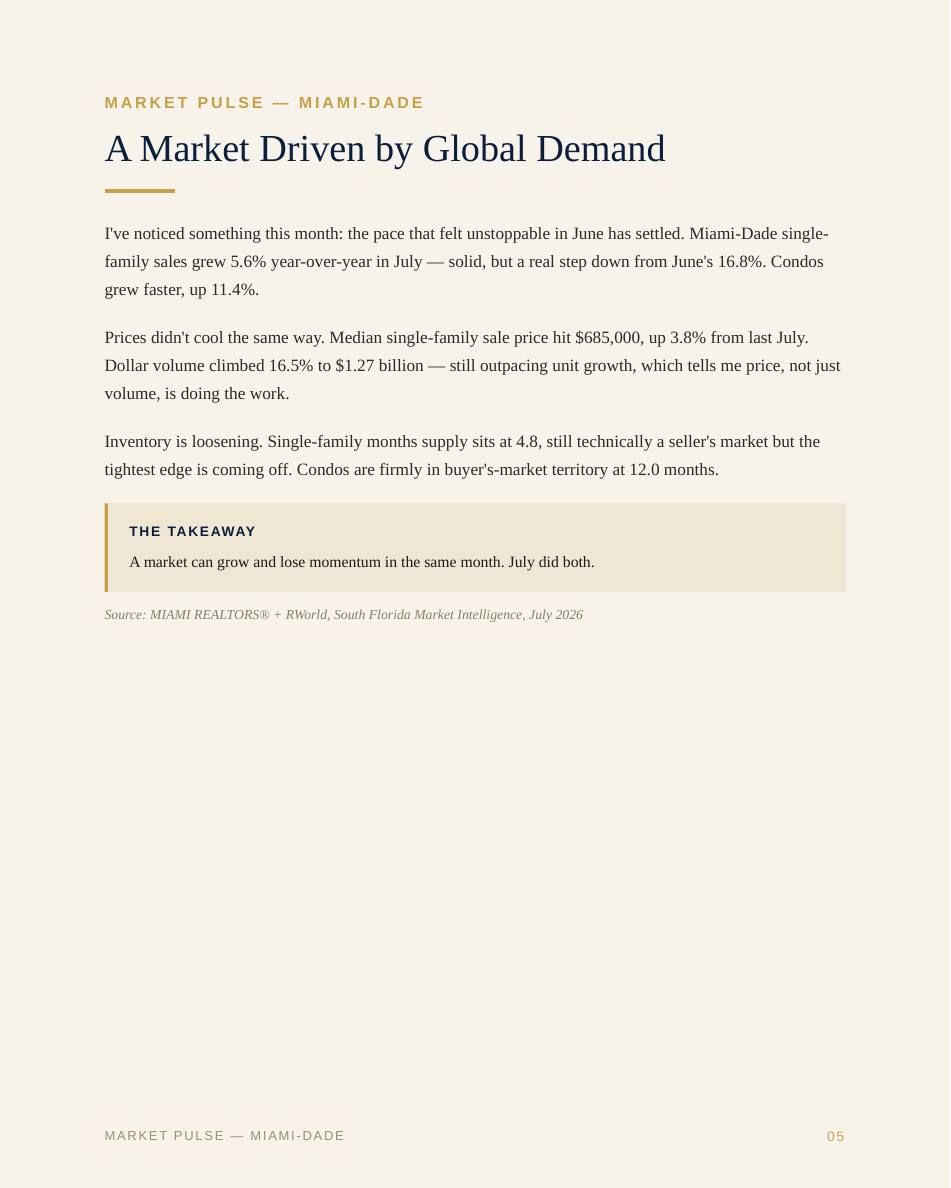
Miami-Dade — A Market Driven by Global Demand
Here's what stood out to me this month: the pace that felt unstoppable in June has settled. Miami-Dade single-family sales grew 5.6% year-over-year in July — solid, but a real step down from June's 16.8%. Condos grew faster, up 11.4%.
Prices didn't cool the same way. Median single-family sale price hit $685,000, up 3.8% from last July. Dollar volume climbed 16.5% to $1.27 billion — still outpacing unit growth, which tells me price, not just volume, is doing the work.
Inventory is loosening. Single-family months supply sits at 4.8, still technically a seller's market but the tightest edge is coming off. Condos are firmly in buyer's-market territory at 12.0 months.
Bottom line: a market can grow and lose momentum in the same month. July did both.
Source: MIAMI REALTORS® + RWorld, South Florida Market Intelligence, July 2026
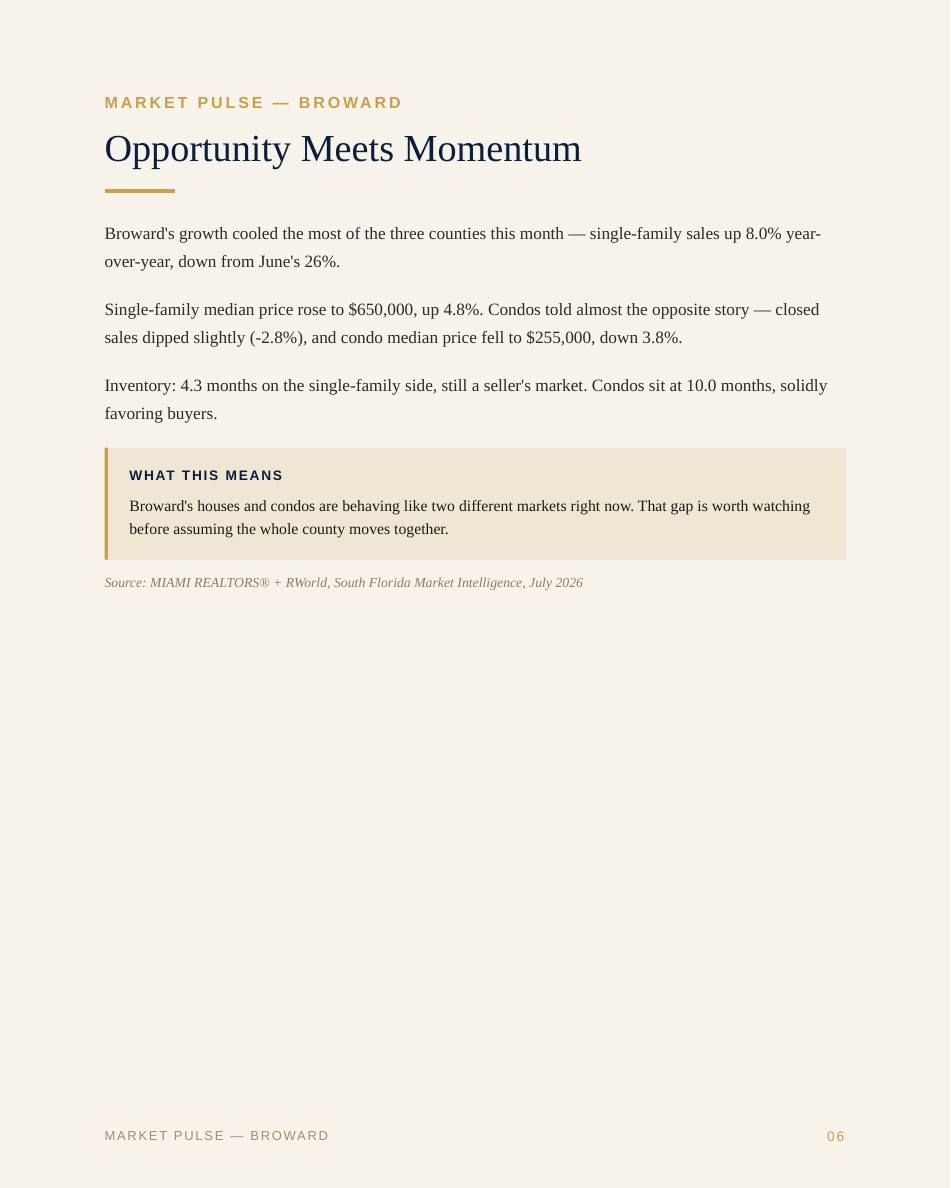
Broward — Opportunity Meets Momentum
Broward's growth cooled the most of the three counties this month — single-family sales up 8.0% year-over-year, down from June's 26%.
Single-family median price rose to $650,000, up 4.8%. Condos told almost the opposite story — closed sales dipped slightly (-2.8%), and condo median price fell to $255,000, down 3.8%.
Inventory: 4.3 months on the single-family side, still a seller's market. Condos sit at 10.0 months, solidly favoring buyers.
Read on that: Broward's houses and condos are behaving like two different markets right now. That gap is worth watching before assuming the whole county moves together.
Source: MIAMI REALTORS® + RWorld, South Florida Market Intelligence, July 2026
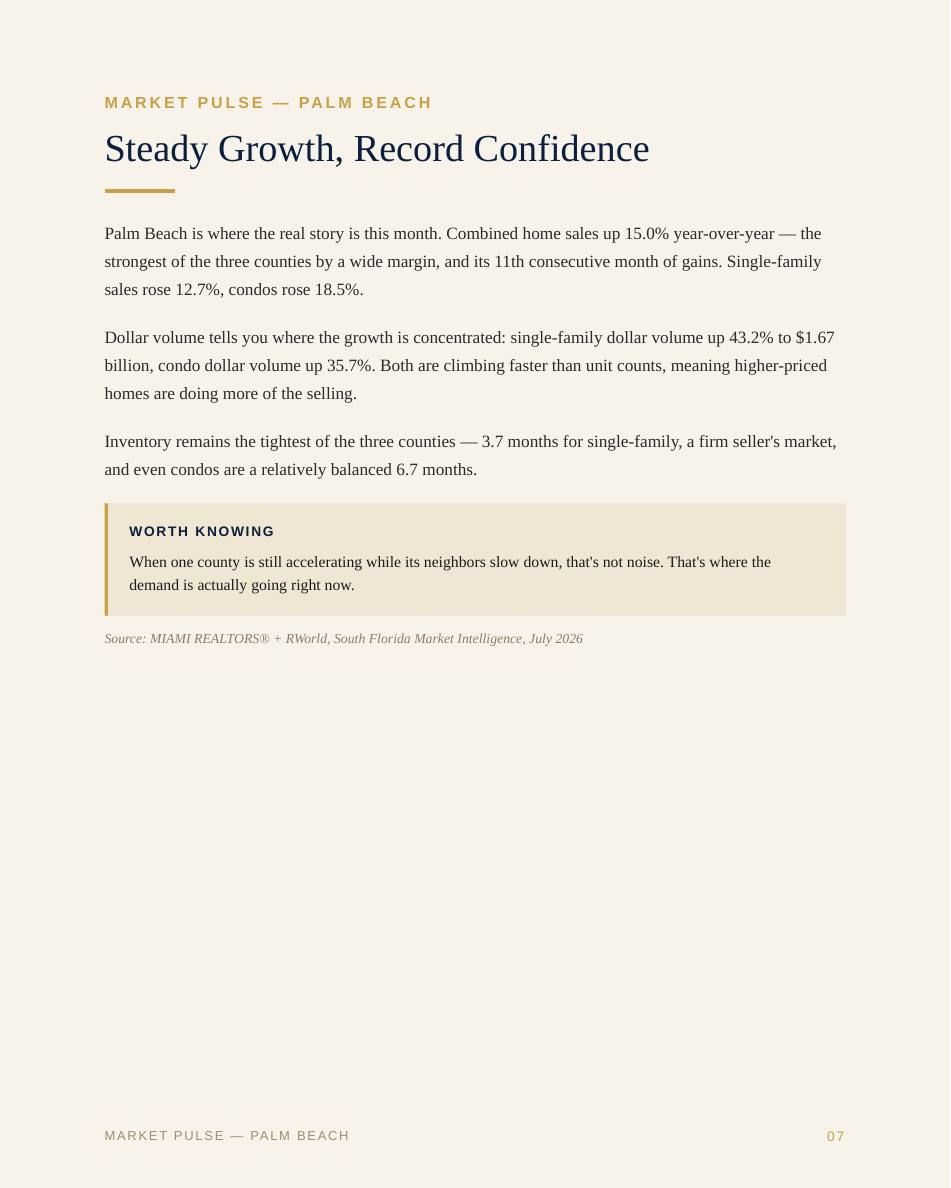
Palm Beach — Steady Growth, Record Confidence
Palm Beach is where the real story is this month. Combined home sales up 15.0% year-over-year — the strongest of the three counties by a wide margin, and its 11th consecutive month of gains. Single-family sales rose 12.7%, condos rose 18.5%.
Dollar volume tells you where the growth is concentrated: single-family dollar volume up 43.2% to $1.67 billion, condo dollar volume up 35.7%. Both are climbing faster than unit counts, meaning higher-priced homes are doing more of the selling.
Inventory remains the tightest of the three counties — 3.7 months for single-family, a firm seller's market, and even condos are a relatively balanced 6.7 months.
One more thing worth flagging: when one county is still accelerating while its neighbors slow down, that's not noise. That's where the demand is actually going right now.
Source: MIAMI REALTORS® + RWorld, South Florida Market Intelligence, July 2026
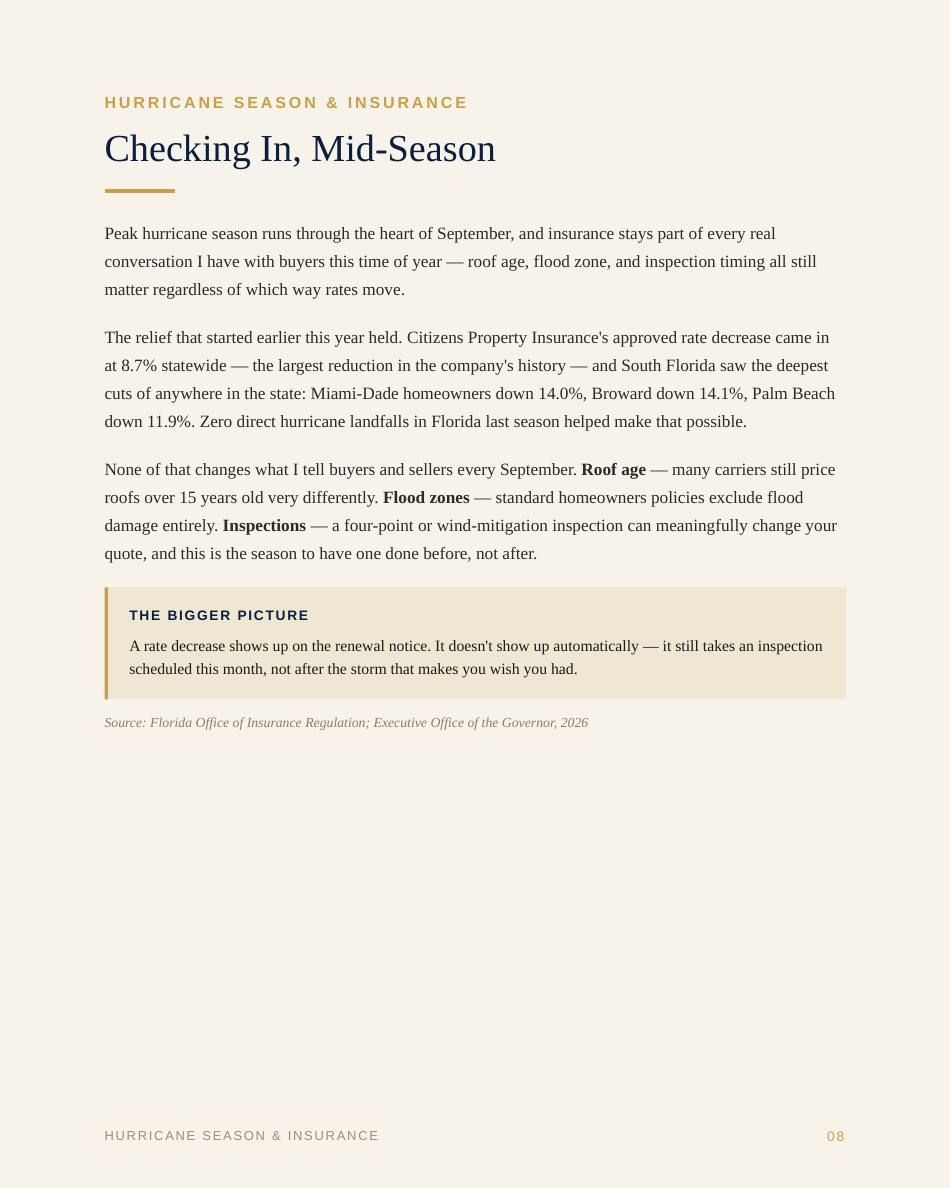
Hurricane Season & Insurance: Checking In, Mid-Season
Peak hurricane season runs through the heart of September, and insurance stays part of every real conversation I have with buyers this time of year — roof age, flood zone, and inspection timing all still matter regardless of which way rates move.
The relief that started earlier this year held. Citizens Property Insurance's approved rate decrease came in at 8.7% statewide — the largest reduction in the company's history — and South Florida saw the deepest cuts of anywhere in the state: Miami-Dade homeowners down 14.0%, Broward down 14.1%, Palm Beach down 11.9%. Zero direct hurricane landfalls in Florida last season helped make that possible.
None of that changes what I tell buyers and sellers every September. Roof age — many carriers still price roofs over 15 years old very differently. Flood zones — standard homeowners policies exclude flood damage entirely. Inspections — a four-point or wind-mitigation inspection can meaningfully change your quote, and this is the season to have one done before, not after.
The bigger picture: A rate decrease shows up on the renewal notice. It doesn't show up automatically — it still takes an inspection scheduled this month, not after the storm that makes you wish you had.
Source: Florida Office of Insurance Regulation; Executive Office of the Governor, 2026
Interest Rates: Beyond the Mortgage Rate
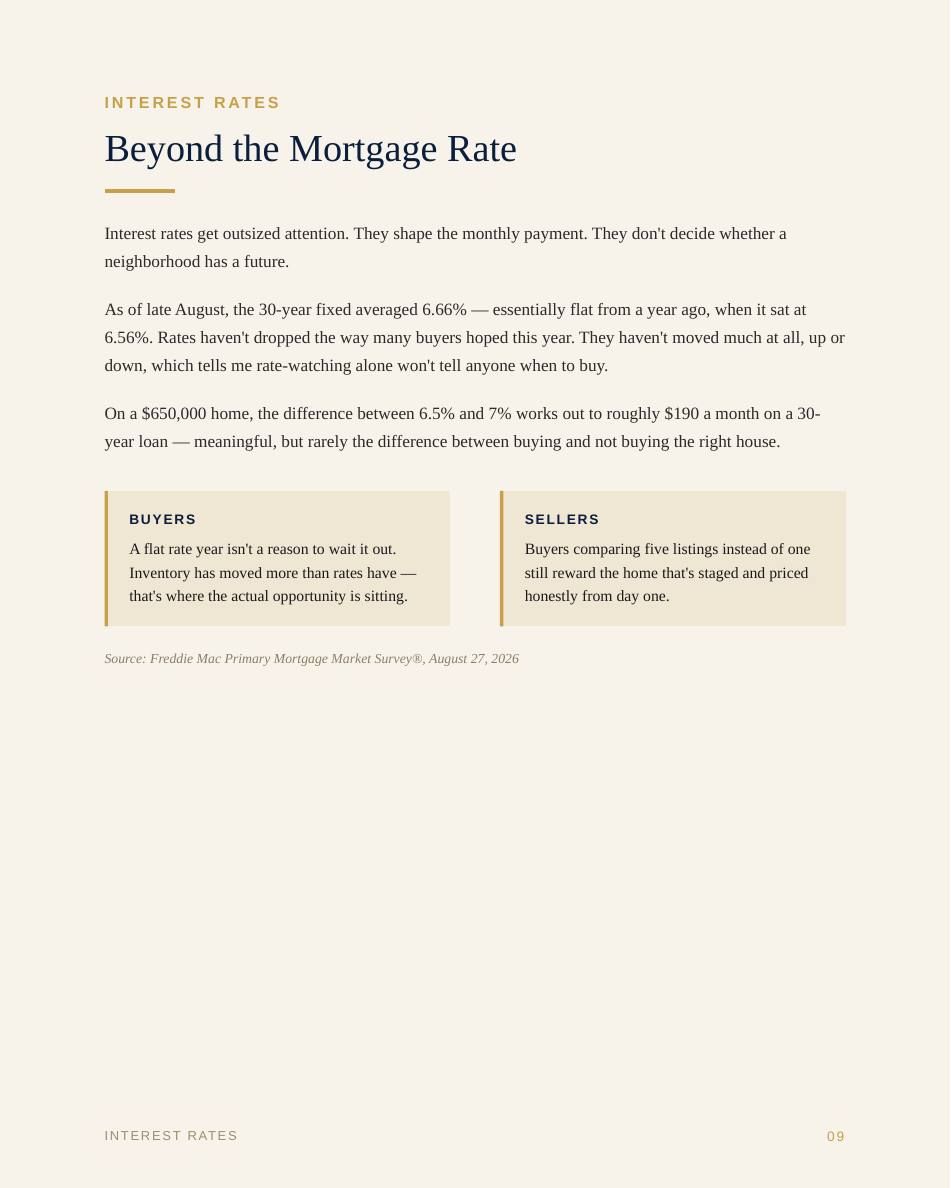
Interest rates get outsized attention. They shape the monthly payment. They don't decide whether a neighborhood has a future.
As of late August, the 30-year fixed averaged 6.66% — essentially flat from a year ago, when it sat at 6.56%. Rates haven't dropped the way many buyers hoped this year. They haven't moved much at all, up or down, which tells me rate-watching alone won't tell anyone when to buy.
On a $650,000 home, the difference between 6.5% and 7% works out to roughly $190 a month on a 30-year loan — meaningful, but rarely the difference between buying and not buying the right house.
Buyers: A flat rate year isn't a reason to wait it out. Inventory has moved more than rates have — that's where the actual opportunity is sitting.
Sellers: Buyers comparing five listings instead of one still reward the home that's staged and priced honestly from day one.
Source: Freddie Mac Primary Mortgage Market Survey®, August 27, 2026
A Hundred-Year-Old Lesson for Buyers: What George Merrick Understood That Spreadsheets Don't
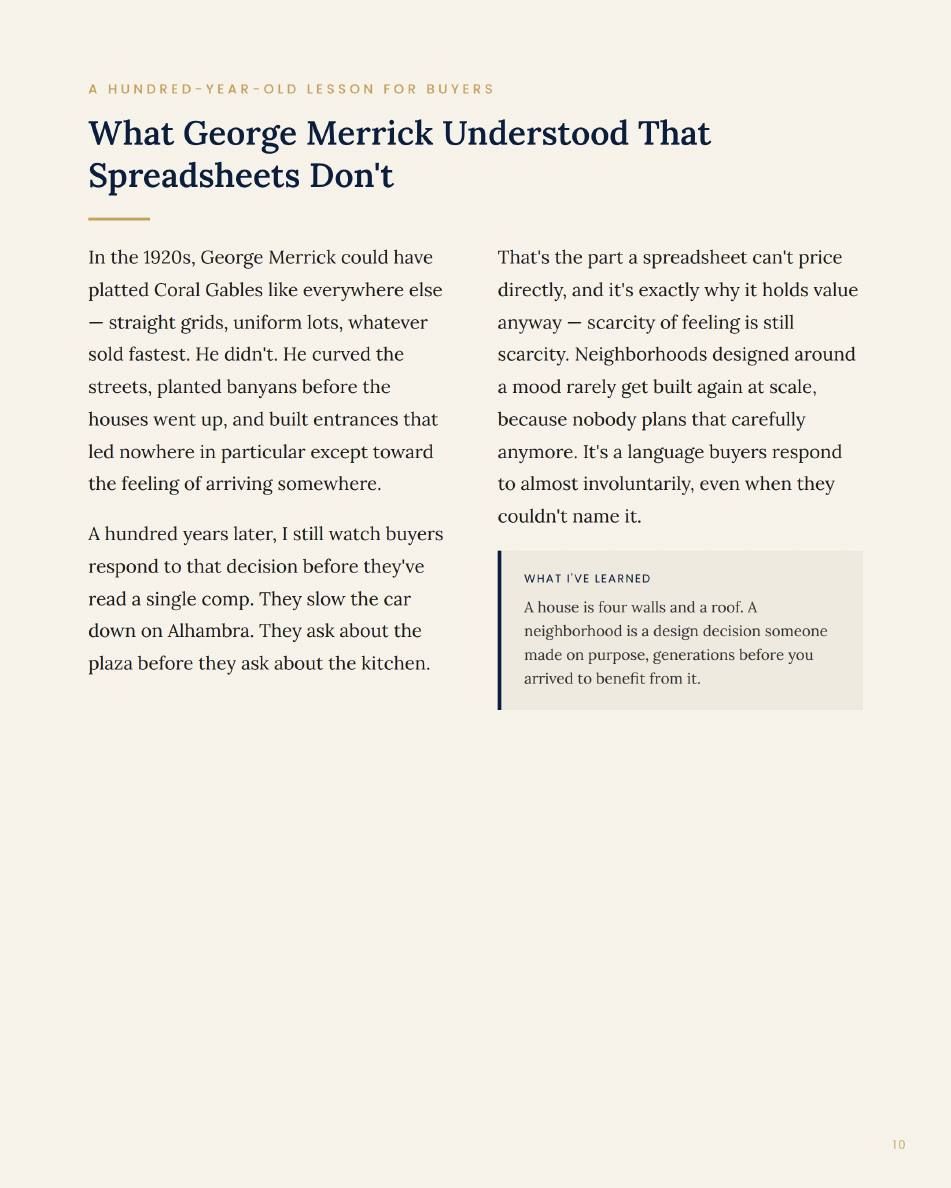
In the 1920s, George Merrick could have platted Coral Gables like everywhere else — straight grids, uniform lots, whatever sold fastest. He didn't. He curved the streets, planted banyans before the houses went up, and built entrances that led nowhere in particular except toward the feeling of arriving somewhere.
A hundred years later, I still watch buyers respond to that decision before they've read a single comp. They slow the car down on Alhambra. They ask about the plaza before they ask about the kitchen.
That's the part a spreadsheet can't price directly, and it's exactly why it holds value anyway — scarcity of feeling is still scarcity. Neighborhoods designed around a mood rarely get built again at scale, because nobody plans that carefully anymore. It's a language buyers respond to almost involuntarily, even when they couldn't name it.
What I've learned: A house is four walls and a roof. A neighborhood is a design decision someone made on purpose, generations before you arrived to benefit from it.
Coffee with Rabia
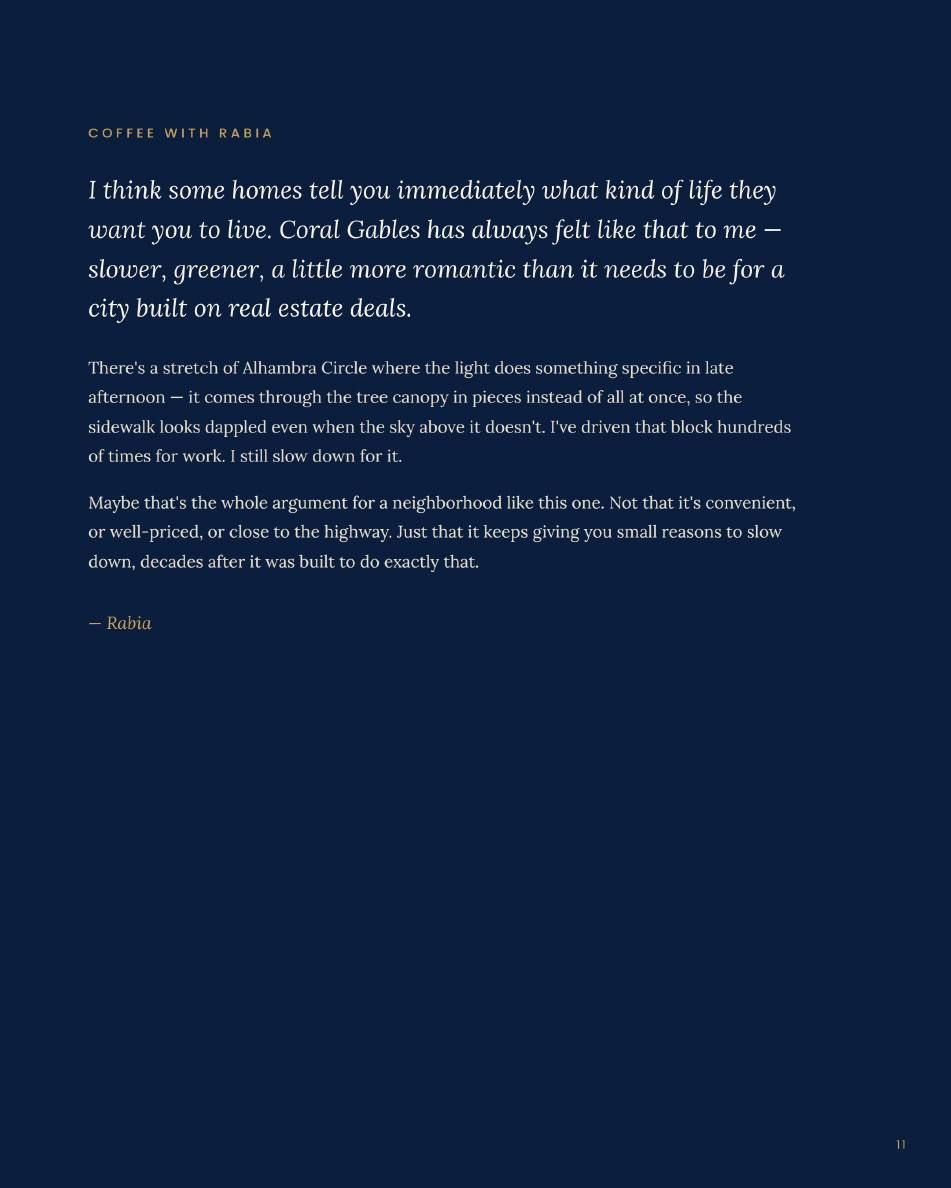
“I think some homes tell you immediately what kind of life they want you to live. Coral Gables has always felt like that to me — slower, greener, a little more romantic than it needs to be for a city built on real estate deals.
There's a stretch of Alhambra Circle where the light does something specific in late afternoon — it comes through the tree canopy in pieces instead of all at once, so the sidewalk looks dappled even when the sky above it doesn't. I've driven that block hundreds of times for work. I still slow down for it.
Maybe that's the whole argument for a neighborhood like this one. Not that it's convenient, or well-priced, or close to the highway. Just that it keeps giving you small reasons to slow down, decades after it was built to do exactly that.” — Rabia
Development Watch: The Places Quietly Shaping Tomorrow
Not every important story begins with a ribbon-cutting. Some begin with a demolition permit, a groundbreaking, or a rendering finally released after months of quiet planning.
This month, two of the four projects I'm watching are right here in Coral Gables — a sign of how much is currently moving in a city that usually changes slowly, on purpose.
Ponce Park. The Allen Morris Company unveiled the amenity collection for Ponce Park this August — wellness, hospitality, and social spaces designed by Meyer Davis, following the recently unveiled residence interiors. Demolition on the site finished in July, and a new on-site sales gallery is opening in its place.
Why it matters: Mixed-use projects that release amenities before residences are betting buyers choose a lifestyle first and a floor plan second.
Seventeen Gables Residences. Construction broke ground this spring on Seventeen Gables, an eight-story, 117-unit condominium at 1715 Douglas Road, developed by BAM Development and Ascendra Capital with Asprea Studio as design architect, backed by a $60 million construction loan.
Why it matters: Douglas Road isn't Coral Gables' postcard corridor — it's the one quietly filling in with mid-rise product, which usually means the postcard corridors get more expensive next.
Sources: PROFILEmiami, Florida YIMBY, August 2026
Elsewhere in South Florida
North Bay Village. Tula Residences — 54 homes, 21 stories, rising over Biscayne Bay from Bayshore Grove Capital and Pacific & Orient Properties. A three-island village that spent decades in nobody's spotlight is suddenly on two developers' short list.
Brickell. 2200 Brickell received its Temporary Certificate of Occupancy this summer and is releasing its final collection — penthouses and garden villas — at 85% sold.
Why it matters: Neither project is in Coral Gables, but both tell you something Coral Gables projects don't — that confidence is showing up in places that weren't obvious bets five years ago.
Sources: PROFILEmiami, August 2026
Pre-construction pricing and phase releases shift by the week — I keep a running list for buyers who want to know before they fall in love with a unit. rabiaroig.mybeachfrontrealty.com
Hidden Miami: Two Gardens, One Idea
[Photo: Fairchild Tropical Botanic Garden, Coral Gables]
Fairchild Tropical Botanic Garden and Matheson Hammock Park sit side by side on Old Cutler Road, and they were shaped by the same hand — landscape architect William Lyman Phillips, who trained under the Olmsted firm and brought that same instinct for wild-looking order to both.
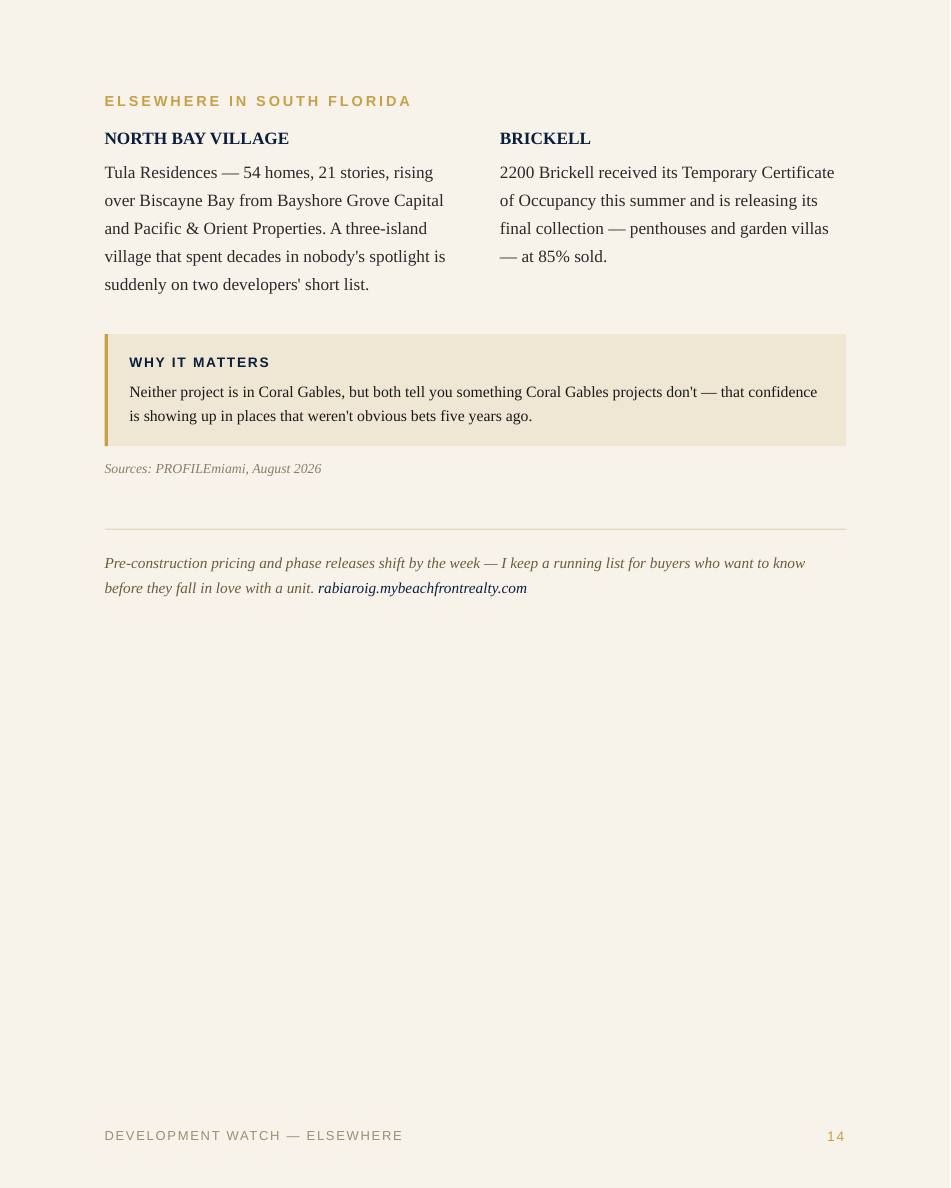
Fairchild opened in 1938. It started with a friendship — Robert H. Montgomery, an accountant with a serious plant habit, bought the land and built the garden, then named it for his friend David Fairchild, the plant explorer whose specimens still grow near the old Gate House. Eighty-three acres later, it holds one of the world's great palm collections, a lake system that draws its own wildlife, and a history that occasionally hangs the past right on the walls — a photograph from around 1940 shows Robert and Nell Montgomery paddling a canoe across the very lakes that still wind through the garden today.
Walk far enough and Fairchild simply opens into Matheson Hammock — the atoll pool, the beach, the mangroves — Phillips's other Coral Gables project, built the same era, same philosophy: let the tropics do most of the design work.
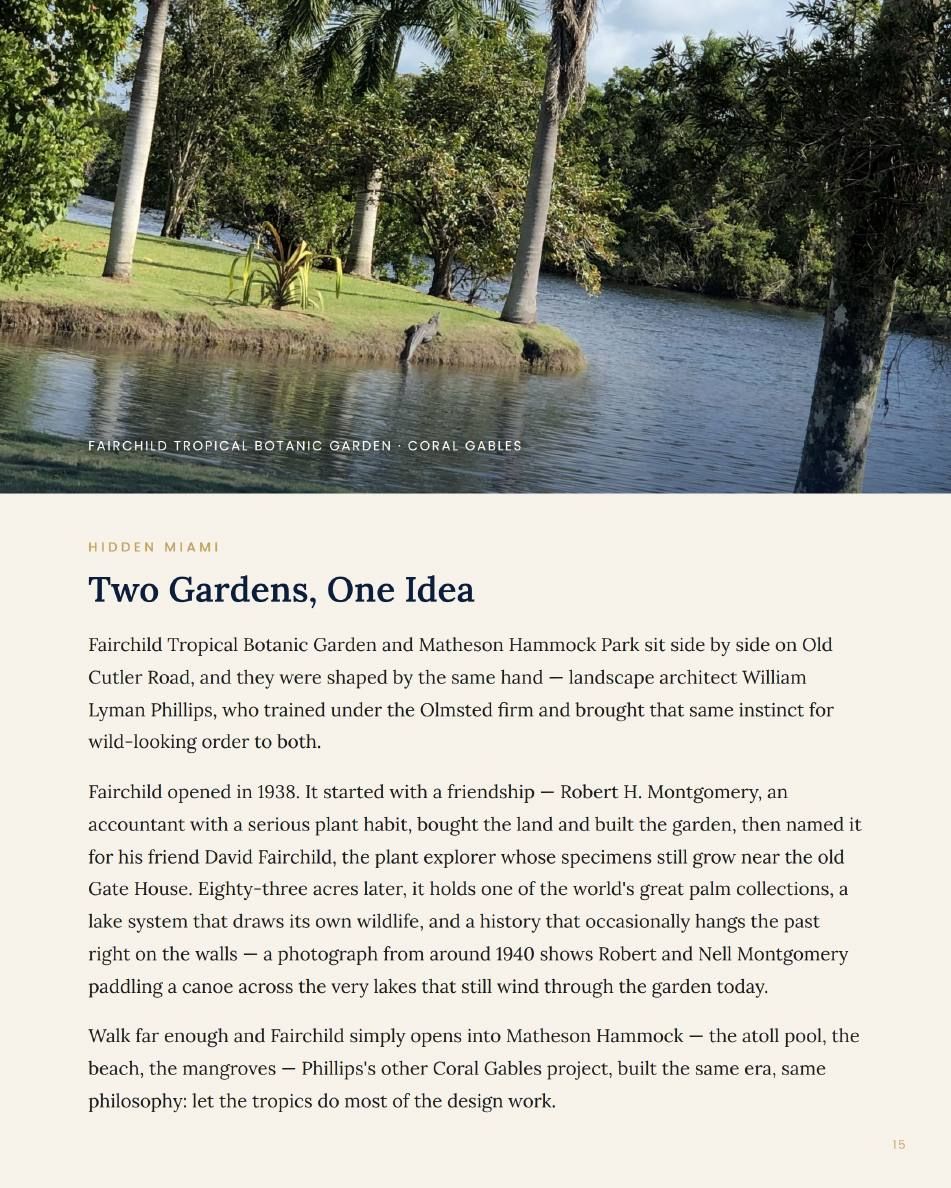
[Photo caption, c. 1940]: Robert & Nell Montgomery, on the garden's own lakes. Some of Fairchild's palms still carry their original collection tags — one, wired to its trunk, marks a specimen gathered from Haiti. A working collection, not just scenery.
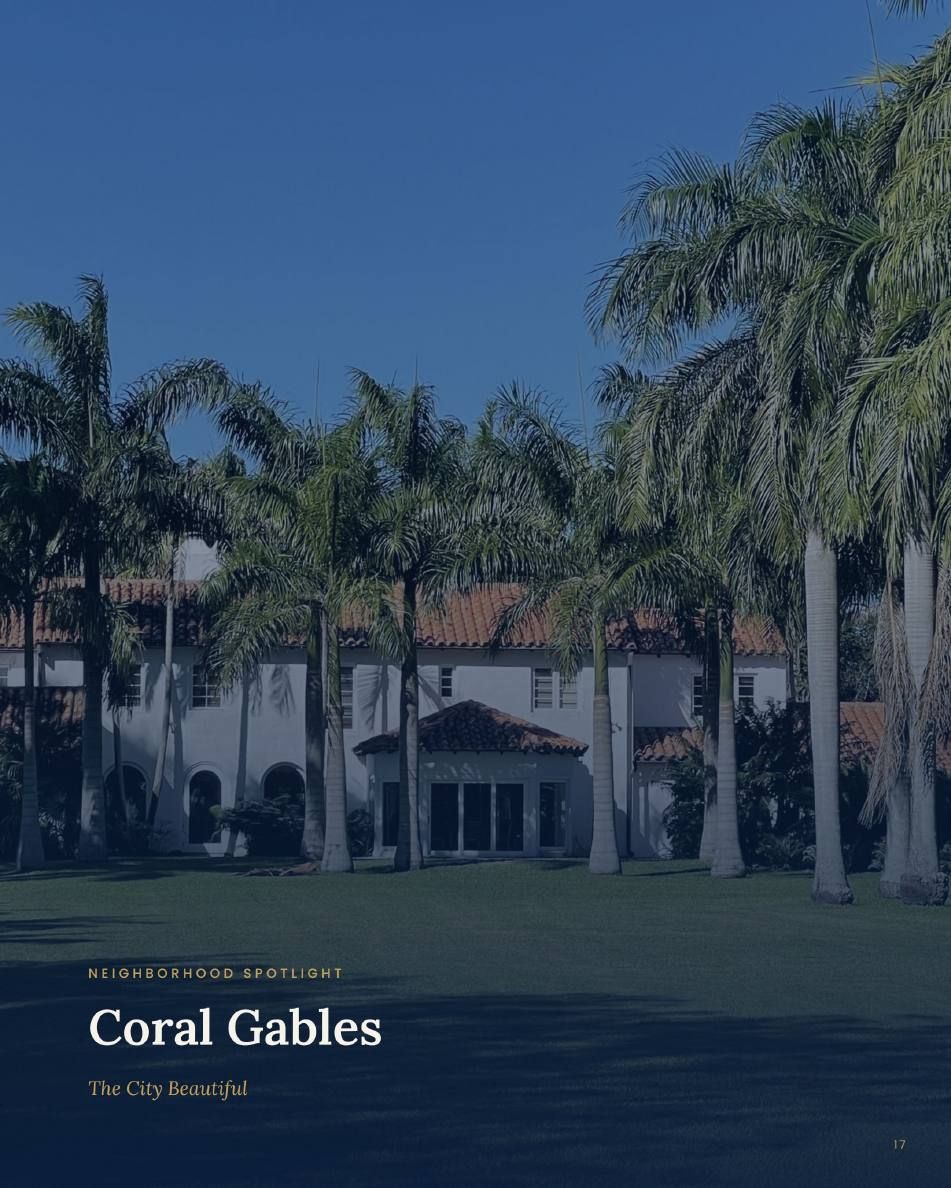
Neighborhood Spotlight — Coral Gables: The City Beautiful
Character. Coral Gables doesn't announce itself. There's no single street that photographs the whole city — no Ocean Drive, no single skyline shot. You have to actually drive it, and even then it takes a few passes before you understand what you're looking at: a city that decided, block by block, what it would allow itself to become, and then held that line for a hundred years.
Streets & Public Spaces. Alhambra curves instead of running straight. Granada dead-ends into a plaza instead of a highway on-ramp. None of that happened by accident, and none of it happens anymore — cities don't plan this patiently, and Coral Gables knows it's holding something increasingly rare. Miracle Mile still closes for parades. The Biltmore's golf course still sits in the middle of the city instead of pushed to its edge. Public space here was never leftover space.
Lifestyle. Walkable in a way few Miami-Dade neighborhoods still are. Miracle Mile's shops and cafés, Giralda Plaza's restaurant row, a genuine café culture that doesn't rush anyone toward the check. You can run actual errands on foot here — that's not a small thing in South Florida.
Real Estate. What separates Coral Gables from neighboring markets is consistency. Deed restrictions and preservation rules that most buyers see as a feature, not friction — because they protect exactly the character that drew people here in the first place. Buyers aren't just purchasing a home. They're purchasing a level of continuity that is increasingly difficult to find elsewhere.
Rabia's Notebook: A buyer once told me she chose her street because of a single banyan root that had pushed up through the sidewalk, unbothered, for what looked like decades. She said if the city let a tree win that fight, she trusted it with everything else too.
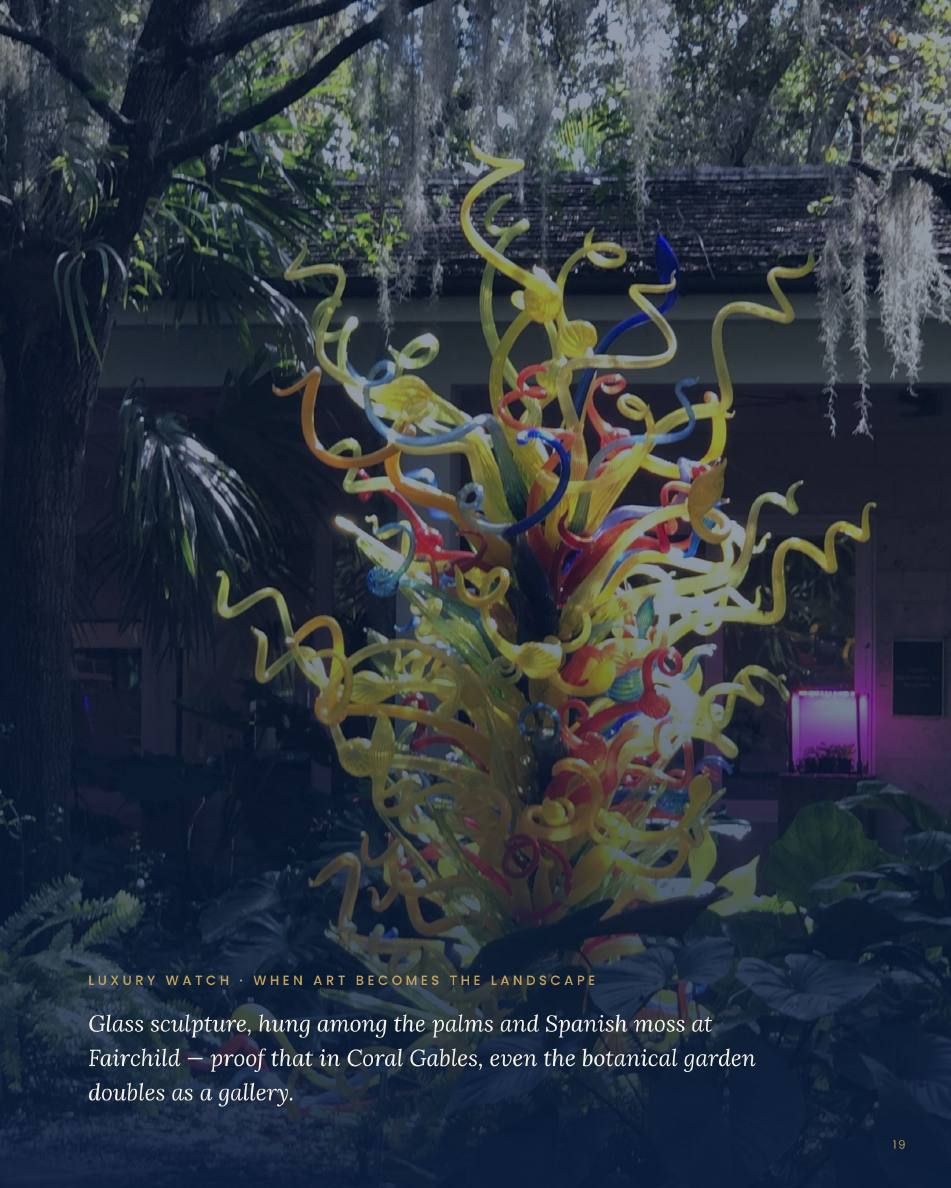
Luxury Watch: When Art Becomes the Landscape
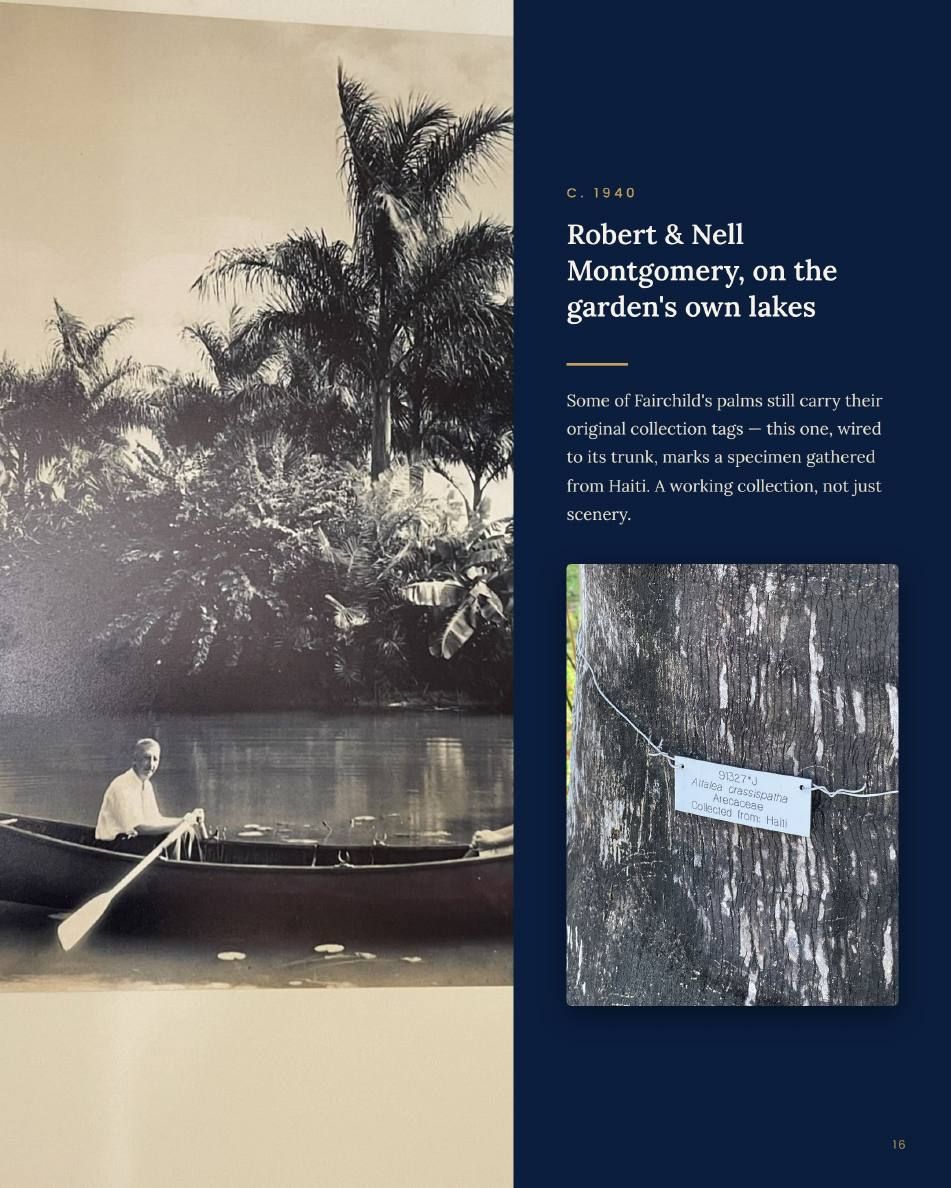
Glass sculpture, hung among the palms and Spanish moss at Fairchild — proof that in Coral Gables, even the botanical garden doubles as a gallery.
Around Town: Three Answers to the Same Question
A buyer once asked me what I'd do with a free morning in Coral Gables that wasn't a showing. I realized I don't actually have one answer — I have three, depending on what she was really asking.
If you want quiet: Fairchild, before the tour groups. Not for the palms — for the fifteen minutes where it's just you and whatever's sunning itself on the lakebank.
If you want company: Giralda Plaza, any table, any hour after the umbrellas or lights go up. You're not there for a specific restaurant. You're there because everyone else decided to be there too, and somehow that's the whole appeal.
If you want to disappear for an hour: Books & Books on Aragon. No agenda, coffee in hand, phone in your bag. Leave with a book you didn't come in looking for.
Rabia's Tip: She picked quiet. Most people do, when you actually ask instead of telling them where to go.
Lifestyle · Art & Culture: The Street That Wears Its Sky
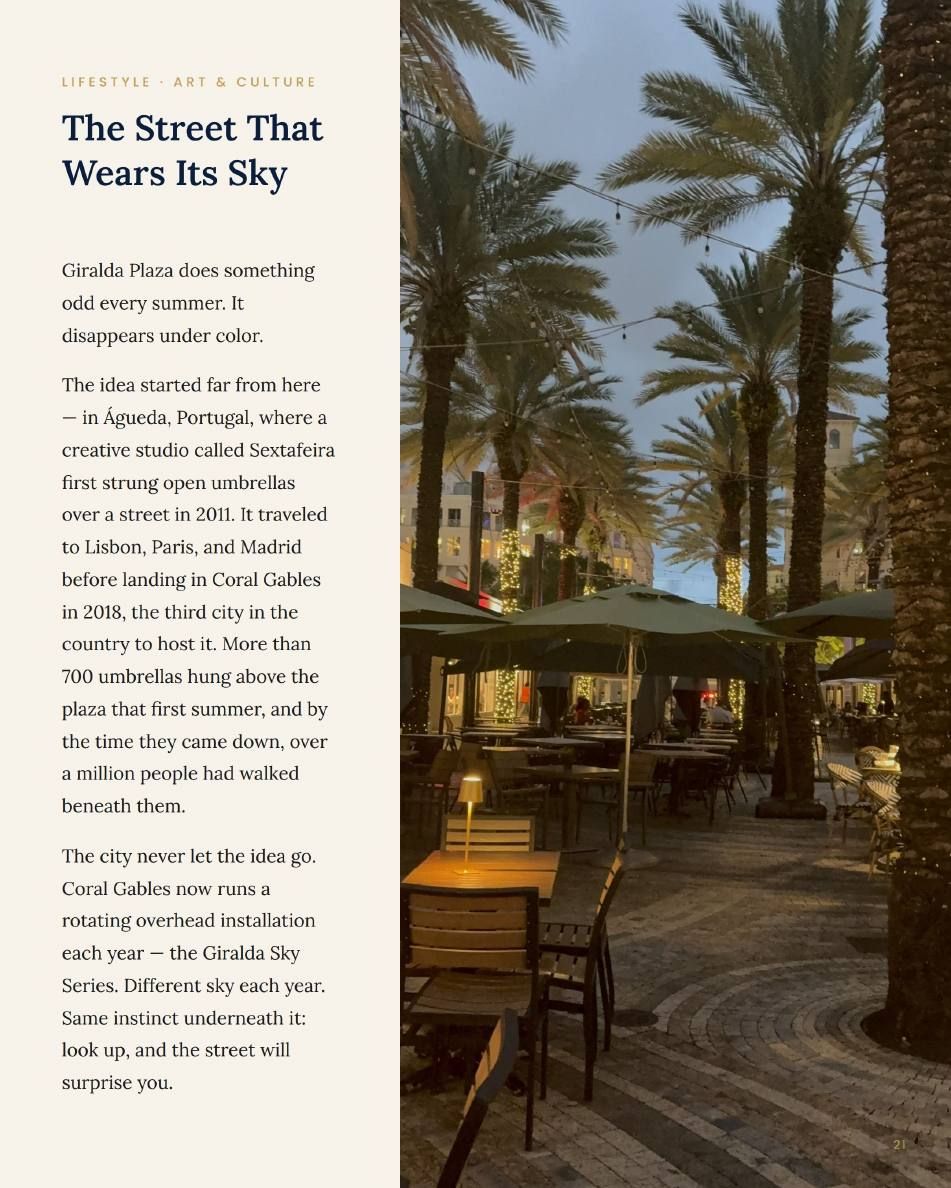
Giralda Plaza does something odd every summer. It disappears under color.
The idea started far from here — in Águeda, Portugal, where a creative studio called Sextafeira first strung open umbrellas over a street in 2011. It traveled to Lisbon, Paris, and Madrid before landing in Coral Gables in 2018, the third city in the country to host it. More than 700 umbrellas hung above the plaza that first summer, and by the time they came down, over a million people had walked beneath them.
The city never let the idea go. Coral Gables now runs a rotating overhead installation each year — the Giralda Sky Series. Different sky each year. Same instinct underneath it: look up, and the street will surprise you.
Weekend Escape: Deering Estate — Twenty minutes from Coral Gables, and three centuries away
Charles Deering, a Chicago industrialist, bought this land in Palmetto Bay in the 1900s and spent his final years there until his death in 1927. Two structures still anchor the 444-acre property: Richmond Cottage, a wooden 1896 building that's the last remnant of the old town of Cutler, and the Stone House, designed in 1922 by Phineas Paist — the same architect behind Coral Gables' old Fire Station and much of its civic Mediterranean face.
The grounds hold the largest virgin coastal tropical hardwood hammock left in the continental United States, plus evidence of Paleo-Indian and Tequesta settlement predating the house by thousands of years. The Stone House is closed for restoration through this year, but the grounds, boardwalks, and Richmond Cottage remain open.
Rabia's Tip: Go for the Moonlight Kayak Tour on a clear night, out to Chicken Key and back. It's the same bay Coral Gables sits on, seen from a completely different angle.
Sources: Deering Estate Foundation, Miami-Dade County Parks, National Register of Historic Places
Did You Know? Four Things You May Not Know About Coral Gables
- Long before “mixed-use” was a marketing term, George Merrick built entire themed pockets into the city — a Chinese Village, a French Normandy Village, a Dutch South African Village — each with its own architectural rules, built within a few years of each other in the 1920s.
- Coral Gables still enforces strict architectural review for anything visible from the street — roofline, color palette, even awning style. It's one of the reasons the city looks the same from one decade to the next.
- The Coral Gables trolley is free to ride and runs along Ponce and Douglas — one of the only ways to see the city without circling for parking.
- The Miracle Theatre, a restored 1948 movie palace on Miracle Mile, still runs as a working stage today, home to Actors' Playhouse.
South Florida Book Club: This Month
Book: Coral Gables: An American Garden City — the closest thing to a biography Merrick's plan has ever gotten. Read it, and you start noticing which streets were designed for people to linger, and which weren't.
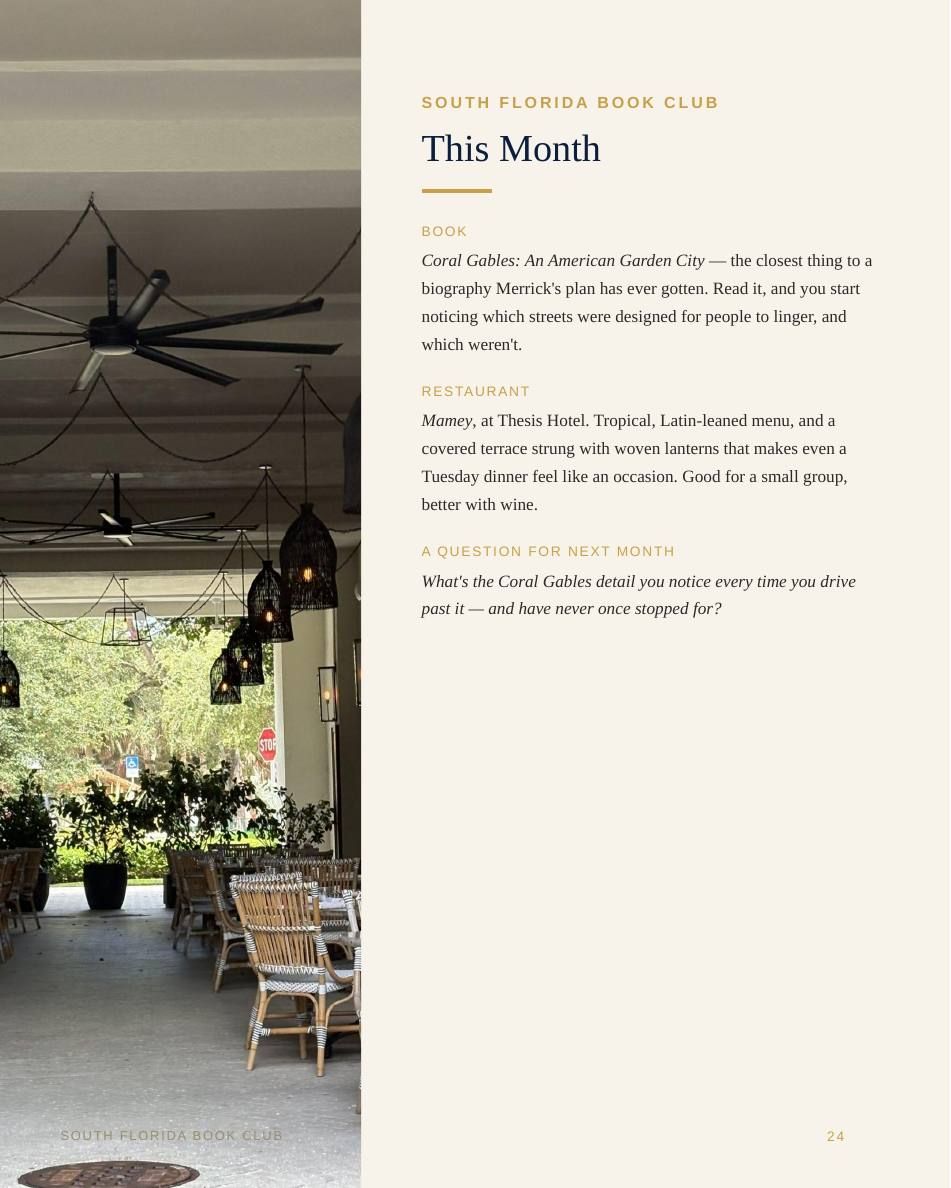
Restaurant: Mamey, at Thesis Hotel. Tropical, Latin-leaned menu, and a covered terrace strung with woven lanterns that makes even a Tuesday dinner feel like an occasion. Good for a small group, better with wine.
A question for next month: What's the Coral Gables detail you notice every time you drive past it — and have never once stopped for?
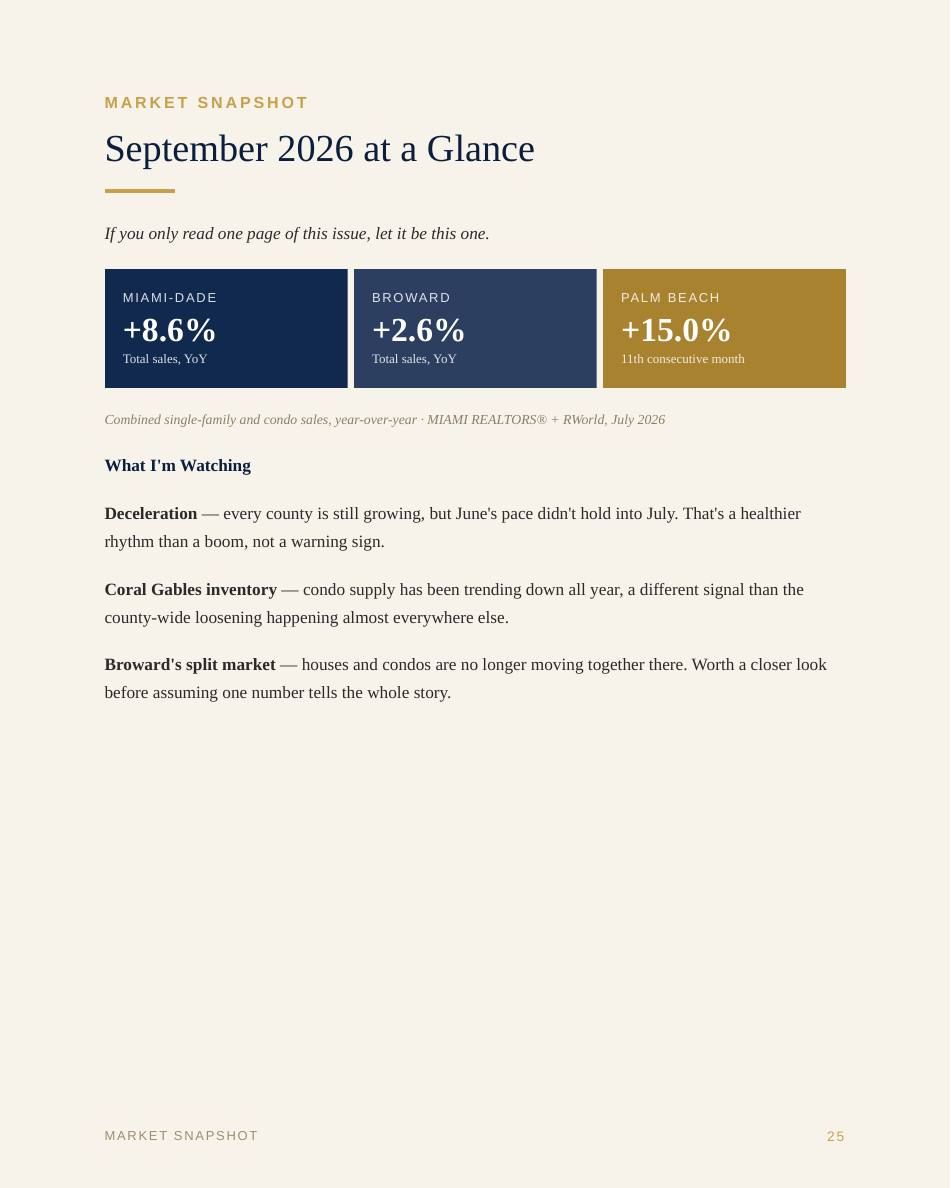
Market Snapshot: September 2026 at a Glance
If you only read one page of this issue, let it be this one.
Miami-Dade +8.6% (total sales, YoY) · Broward +2.6% (total sales, YoY) · Palm Beach +15.0% (11th consecutive month)
Combined single-family and condo sales, year-over-year · MIAMI REALTORS® + RWorld, July 2026
What I'm Watching
Deceleration — every county is still growing, but June's pace didn't hold into July. That's a healthier rhythm than a boom, not a warning sign.
Coral Gables inventory — condo supply has been trending down all year, a different signal than the county-wide loosening happening almost everywhere else.
Broward's split market — houses and condos are no longer moving together there. Worth a closer look before assuming one number tells the whole story.
Until Next Month
I keep coming back to that gator on the lakebank at Fairchild. Not because it did anything remarkable — it just sat there, the whole time I was watching, entirely unconcerned with being watched.
Maybe that's the closest thing Coral Gables has to a mascot. A city built to impress, that somehow still holds a few corners that couldn't care less whether you noticed them.
I don't know why that's stayed with me more than most of this month's showings. Maybe some moments don't need a reason.
Until next month.
— Rabia
Next Month — October 2026: October Is Coming
The next issue takes us somewhere different — a slower pace, a version of Miami-Dade that doesn't photograph the way Coral Gables does.
I don't want to name it yet. Some places deserve their own introduction, not a preview.
What I can tell you: it's going to feel like a Sunday drive with nowhere particular to be. That's usually where the good stories are.
Property Management: The Part of Ownership Nobody Asks About Until They Need It
Most people think about property management the way they think about insurance — not at all, until something goes wrong. I became a Certified Community Association Manager for exactly that reason. Owning a rental, sitting on an HOA board, or managing a condo association comes with a level of detail that rarely shows up in the listing photos: tenant coordination, maintenance that can't wait, budgets that need to balance, and a state regulatory landscape that changes more often than most owners realize.
If you own rental property, sit on a board, or are simply tired of being the person everyone calls at 9pm about a leak, this is the part of the business I quietly handle for a number of clients — tenant management and lease coordination, maintenance and repairs, HOA and budget oversight, and keeping everything compliant with Florida property law as it evolves.
It's not glamorous work. It's the work that protects the investment once the closing is long over.
Let's Talk: If any of this sounds like something you've been putting off, it's a conversation worth having before it becomes urgent.
Thank you for reading, sharing, asking thoughtful questions, and trusting me as your resource. South Florida continues to evolve — and navigating it well requires perspective, patience, and good information.
With appreciation and warmth,
Let's Stay in Touch
As we head into fall, it's a great time to pause, refocus, and realign your goals. South Florida remains full of movement and opportunity — especially in specific neighborhoods and property types that continue to outperform.
Need a personalized market update or a home valuation? I'll gladly prepare one for you — just ask!
Rabia Mohad Ep Roig — Your Dedicated Team: We Speak English, French, Spanish & Arabic
As a Certified International Property Specialist, I work alongside real estate professionals worldwide — from North, Central, and South America to the Caribbean, Europe (including France, Spain, and Italy), the Middle East, Asia, and Africa (especially Morocco and Nigeria). That network lets me help clients navigate cross-border investments with trusted local experts, so every transaction stays seamless and every insight stays relevant, wherever in the world it's coming from.
Whether you're considering Miami as a new investment or looking for a second home abroad, I have the network to make it happen.
Contact
305-484-4367 · onshorerealty@gmail.com
 rabiaroig.mybeachfrontrealty.com
Categories
- All Blogs (22)
- Buying & Investment Guides (2)
- Coral gables (1)
- FLORIDA (5)
- foreign investment (1)
- Fort Lauderdale (1)
- Globalconflict (1)
- HISTORY (4)
- Homestead Florida (1)
- HUMOUR (1)
- INFO (5)
- investment (5)
- KEY BISCAYNE (1)
- Lifestyle & Culture (3)
- Lifestyle real estate (3)
- Market Intelligence (12)
- Miami (6)
- Miami-Dade Communities South Miami (2)
- Neighborhoods & Local Guides (10)
- REALESTATE (10)
- south Florida Neighborhoods (2)
- Things to do in Homestead (1)
- TOURISM (4)
Recent Posts

