
Miami Real Estate Magazine — July 2026 (Vol. 1, Issue 1)


 In This Issue Editor's Note · Market Pulse · Interest Rates · The Numbers Behind the Headlines · Development Watch · Neighborhood Spotlight · Luxury Watch · Lifestyle · Coffee with Rabia · Market Snapshot · Worth Reading · Coming Next Month
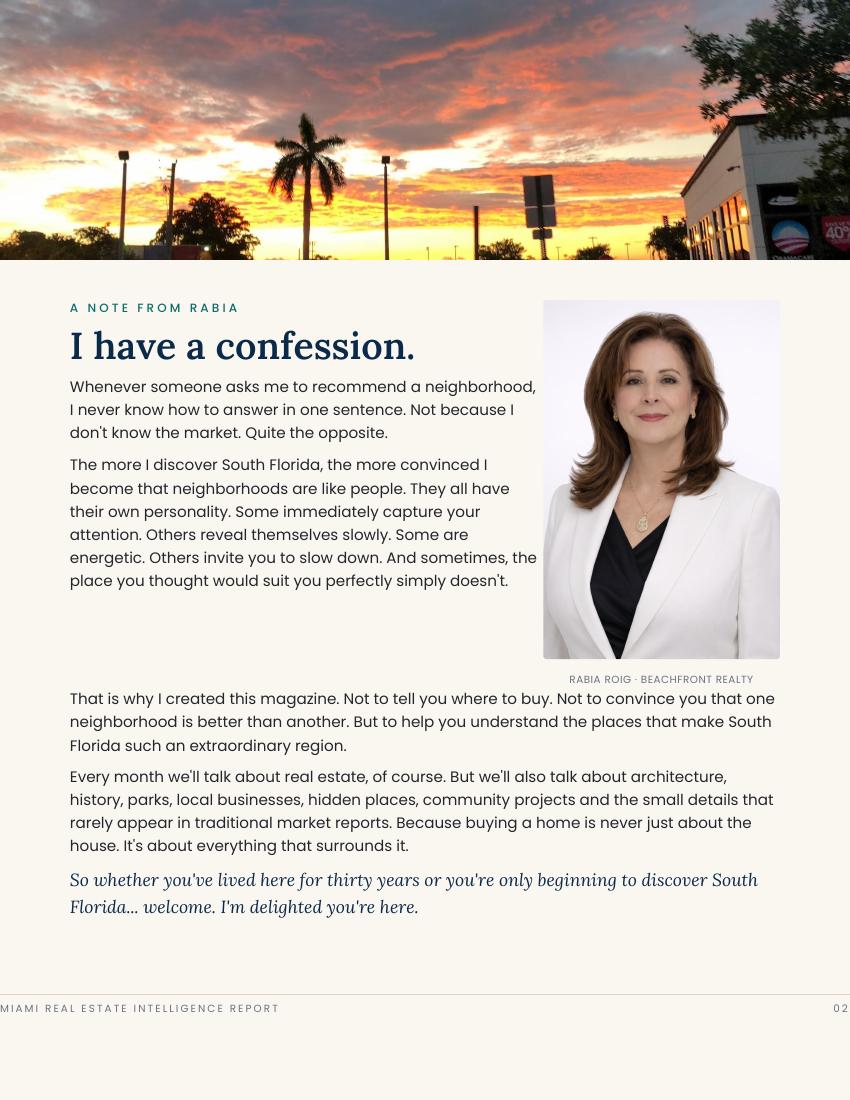
A Note from Rabia
I have a confession.
Whenever someone asks me to recommend a neighborhood, I never know how to answer in one sentence.
Not because I don't know the market. Quite the opposite.
The more I discover South Florida, the more convinced I become that neighborhoods are like people. They all have their own personality. Some immediately capture your attention. Others reveal themselves slowly. Some are energetic. Others invite you to slow down. And sometimes, the place you thought would suit you perfectly simply doesn't.
That is why I created this magazine. Not to tell you where to buy. Not to convince you that one neighborhood is better than another. But to help you understand the places that make South Florida such an extraordinary region.
Every month we'll talk about real estate, of course. But we'll also talk about architecture, history, parks, local businesses, hidden places, community projects and the small details that rarely appear in traditional market reports. Because buying a home is never just about the house. It's about everything that surrounds it.
So whether you've lived here for thirty years or you're only beginning to discover South Florida... Welcome. I'm delighted you're here.
Market Pulse: The Numbers Tell Us What. Communities Tell Us Why.
Every month brings the same questions. "Should I wait?" "Is now a good time to buy?" "Are prices finally coming down?"
Market reports can answer part of those questions, but never all of them. Statistics tell us where the market has been. They cannot fully explain where it is going. Behind every sale is a family starting a new chapter, an entrepreneur relocating a business, retirees choosing a warmer climate, or an investor looking beyond today's headlines.
That is why I believe real estate should never be reduced to percentages alone. Employment, migration, new construction, interest rates, infrastructure, and neighborhood desirability all interact to shape a market. Understanding those relationships is often more valuable than memorizing a single statistic.
The pages that follow are not predictions. They are a snapshot of today's market and an invitation to better understand the communities that continue shaping South Florida.
South Florida Market Snapshot
South Florida continues to demonstrate remarkable resilience. While many regions across the country are experiencing slower activity, our market remains supported by strong population growth, international investment, limited land for new development, and an economy that continues attracting businesses and skilled professionals.
Although each county follows its own rhythm, together they illustrate a region that continues evolving rather than slowing down. Buyers today enjoy more information and greater choice, while sellers who understand current market conditions remain well positioned to achieve successful outcomes.
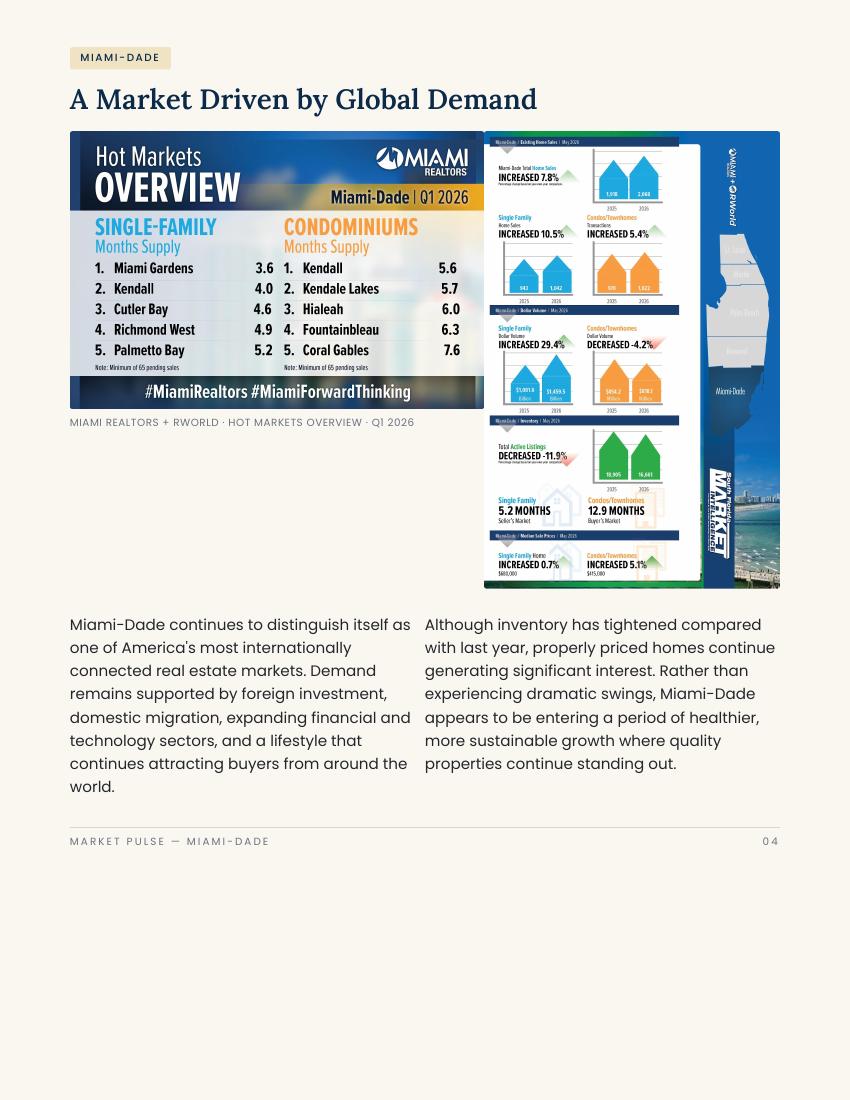
Miami-Dade — A Market Driven by Global Demand. Miami-Dade continues to distinguish itself as one of America's most internationally connected real estate markets. Demand remains supported by foreign investment, domestic migration, expanding financial and technology sectors, and a lifestyle that continues attracting buyers from around the world. Although inventory has tightened compared with last year, properly priced homes continue generating significant interest. Luxury properties remain active, while many established neighborhoods continue benefiting from ongoing redevelopment and infrastructure improvements. Rather than experiencing dramatic swings, Miami-Dade appears to be entering a period of healthier, more sustainable growth where quality properties continue standing out.
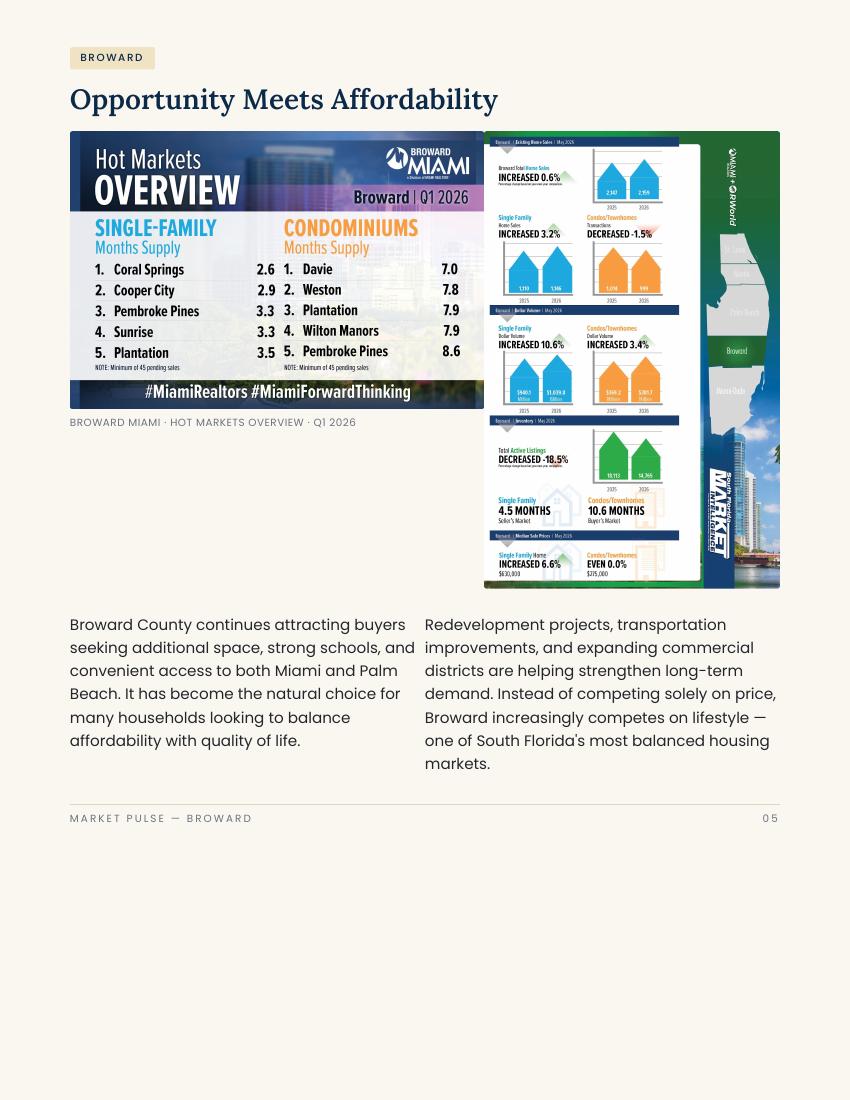
Broward — Opportunity Meets Affordability. Broward County continues attracting buyers seeking additional space, strong schools, and convenient access to both Miami and Palm Beach. It has become the natural choice for many households looking to balance affordability with quality of life. Market activity suggests continued confidence despite changing national conditions. Redevelopment projects, transportation improvements, and expanding commercial districts are helping strengthen long-term demand across many communities. Instead of competing solely on price, Broward increasingly competes on lifestyle, making it one of South Florida's most balanced housing markets.
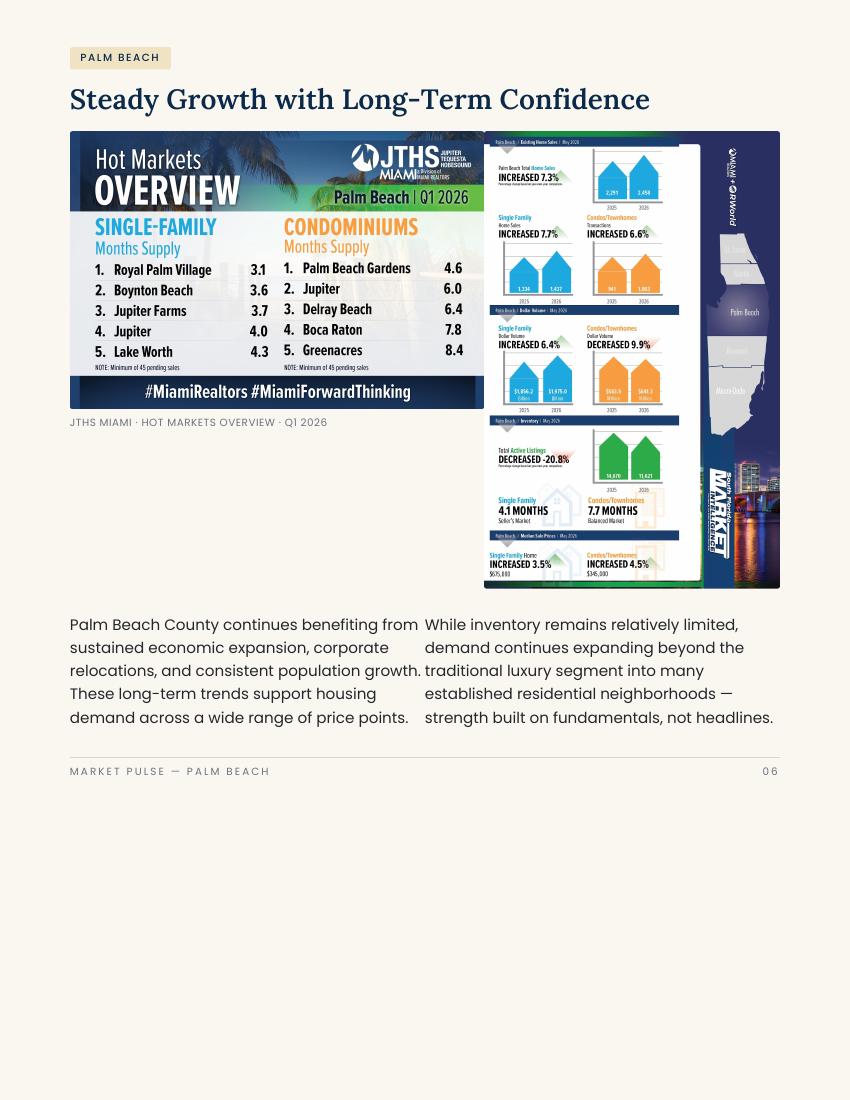
Palm Beach — Steady Growth with Long-Term Confidence. Palm Beach County continues benefiting from sustained economic expansion, corporate relocations, and consistent population growth. These long-term trends support housing demand across a wide range of price points. Communities throughout the county continue attracting professionals, retirees, and families seeking larger homes, excellent amenities, and a high quality of life. While inventory remains relatively limited, demand continues expanding beyond the traditional luxury segment into many established residential neighborhoods. Palm Beach's strength lies not only in today's market performance but in the long-term fundamentals that continue supporting future growth.
What These Reports Really Tell Us
Numbers deserve attention—but they deserve context even more. Inventory rises and falls. Mortgage rates fluctuate. Sales volumes accelerate and slow. Those changes are part of every real estate cycle. What remains remarkably consistent is the value people place on strong communities, quality neighborhoods, and homes that support the lives they want to build.
That is why every market should be viewed through two lenses: the data that explains today's conditions and the human stories that shape tomorrow's opportunities.
My Perspective
People often ask me whether they should wait for the "perfect" market. After years of studying South Florida, I've come to believe that perfect markets rarely exist. There will always be another headline, another forecast, another opinion predicting what comes next. But buying or selling a home is rarely just a financial decision. It reflects a family's goals, a career opportunity, a retirement dream, or the desire for a different lifestyle.
The best decisions are rarely made by trying to predict the exact top or bottom of the market. They come from understanding your priorities, preparing carefully, and recognizing the right opportunity when it appears.
Markets will continue changing. Communities will continue growing. And informed decisions will always outperform emotional reactions.
Development Watch: The Places Quietly Shaping Tomorrow
Not every important story begins with a ribbon-cutting ceremony. Some begin with a construction fence. Others with a new road, a vacant lot, or a simple sign announcing that something is coming soon. These projects rarely make national headlines, yet they often become the foundations of tomorrow's neighborhoods.
Numbers tell part of the story, and neighborhoods tell another - but neither one is complete without watching what's actually being built. This month, several developments caught my attention - not because they are the biggest, but because together they illustrate how South Florida continues to evolve.
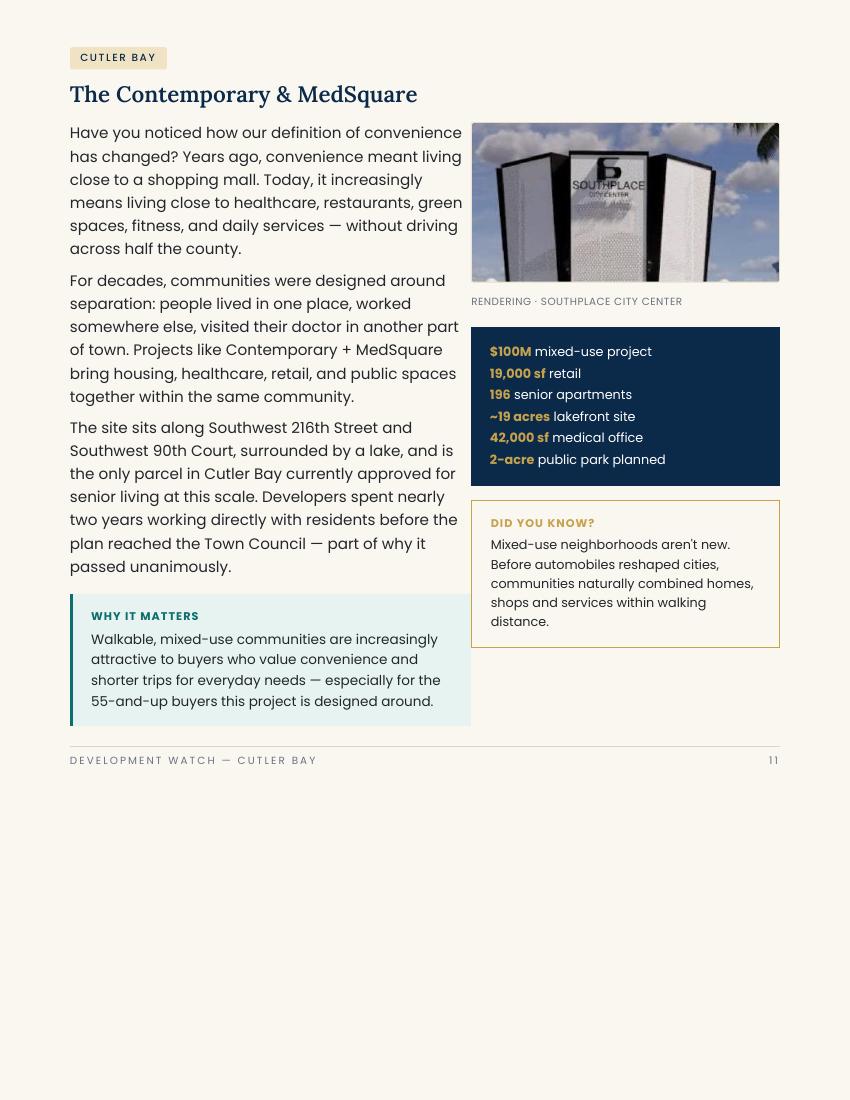
The Contemporary & MedSquare — Cutler Bay.
For decades, communities were designed around separation. People lived in one place, worked somewhere else, visited their doctor in another part of town, and drove again for shopping or dinner. Projects like Contemporary + MedSquare reflect a different philosophy. Housing, healthcare, retail, and public spaces are brought together within the same community. The goal isn't simply to build more residences. It is to make everyday life easier.
The site sits along Southwest 216th Street and Southwest 90th Court, surrounded by a lake, and is the only parcel in Cutler Bay currently approved for senior living at this scale. Developers spent nearly two years working directly with residents before the plan reached the Town Council - part of why it passed unanimously.
The practical upside: walkable, mixed-use communities are increasingly attractive to buyers who value convenience and shorter trips for everyday needs - especially for the 55-and-up buyers this project is designed around.
Link at SoMi — South Miami.
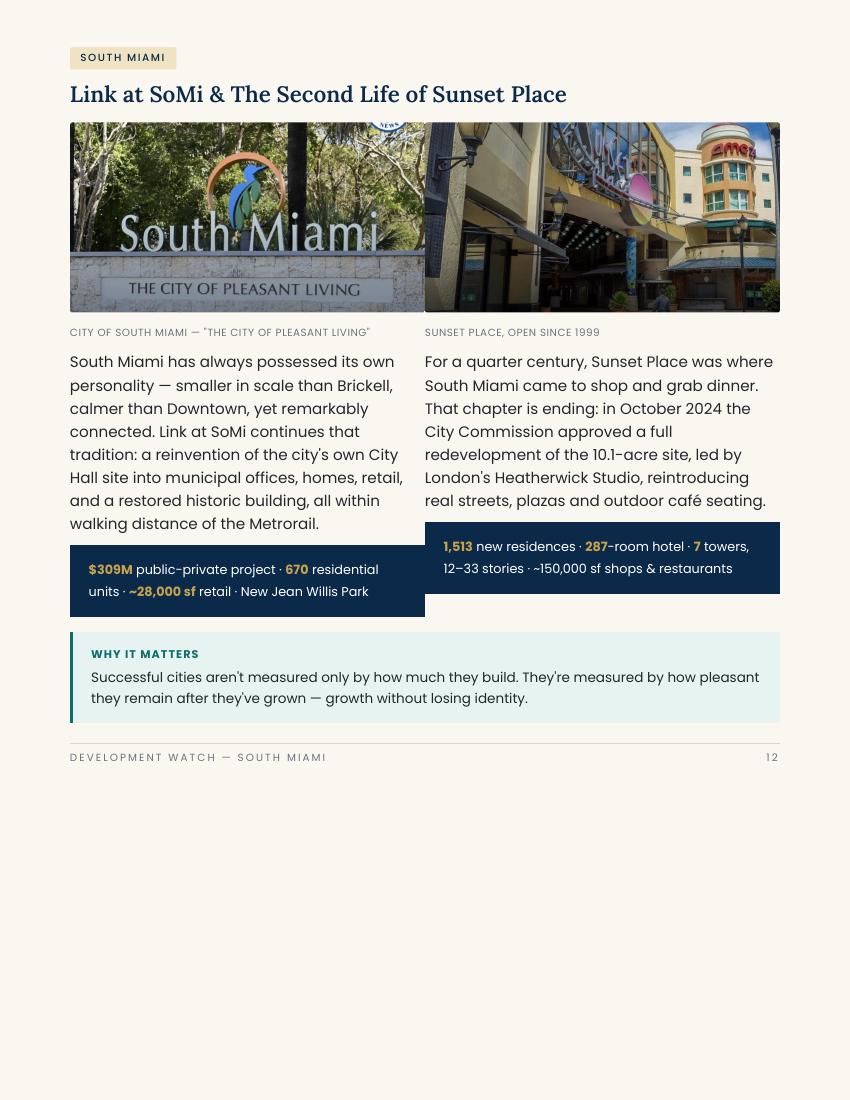
South Miami has always possessed its own personality. Smaller in scale than Brickell, calmer than Downtown, yet remarkably connected. Link at SoMi continues that tradition - not as a new retail district, but as a reinvention of the city's own City Hall site into municipal offices, homes, retail, and a restored historic building, all within walking distance of the Metrorail.
Why it matters: Projects like this demonstrate how thoughtful urban planning can strengthen an existing neighborhood instead of replacing its identity.
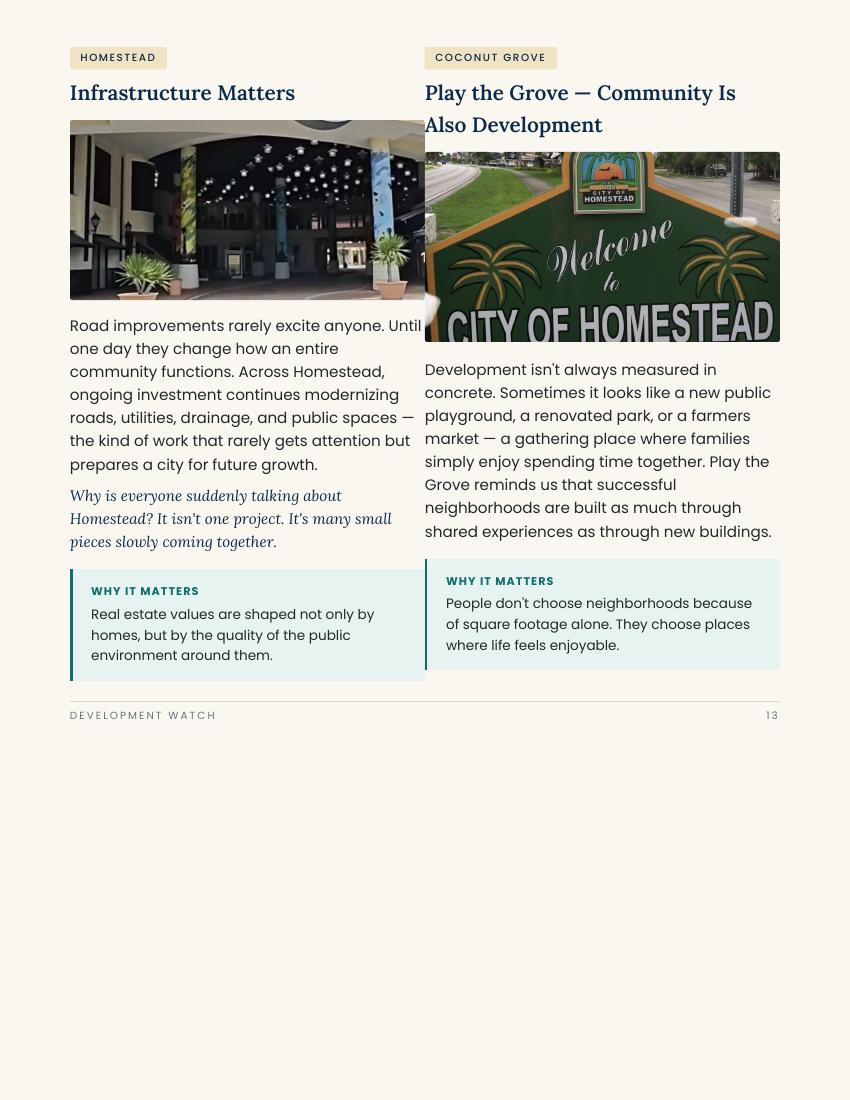
Sunset Place — South Miami's Second Life.
For a quarter century, Sunset Place was where South Miami came to shop, catch a movie, and grab dinner. Lately it has been mostly empty storefronts and quiet walkways. That chapter is ending. In October 2024, the South Miami City Commission unanimously approved a complete redevelopment of the 10.1-acre site, and demolition is targeted to begin this year.
The design team, led by London's Heatherwick Studio, is reintroducing real streets through the site - replacing the enclosed mall model with walkable blocks, plazas, and outdoor cafe seating. The developer, Midtown Development, is required to bring the property to a $300 million valuation by 2034 as part of its agreement with the city. Longtime tenants Deli Lane and Sunset Tavern, both open since 1988, will relocate nearby rather than close for good. The first phase - new streets and a condo-hotel - is targeted for 2029, with the full build-out expected to take up to a decade.
Infrastructure Matters — Homestead.
Road improvements rarely excite anyone. Until one day they change how an entire community functions. Across Homestead, ongoing investment continues modernizing roads, utilities, drainage, and public spaces. These projects rarely get much attention, because their impact is gradual - but history repeatedly shows that communities investing in infrastructure are often preparing for future growth.
Here's the thing: real estate values are shaped not only by homes, but by the quality of the public environment around them. Infrastructure is one of the least glamorous - and most important - investments a city can make.
Community Is Also Development — Play the Grove, Coconut Grove.
Development isn't always measured in concrete. Sometimes it looks like a new public playground, a renovated park, a cultural event, or a farmers market - a gathering place where families simply enjoy spending time together. Play the Grove is one example. It reminds us that successful neighborhoods are built as much through shared experiences as they are through new buildings.
And that's the real point: people don't choose neighborhoods because of square footage alone. They choose places where life feels enjoyable - and that feeling becomes part of a community's long-term value.
Local Discovery
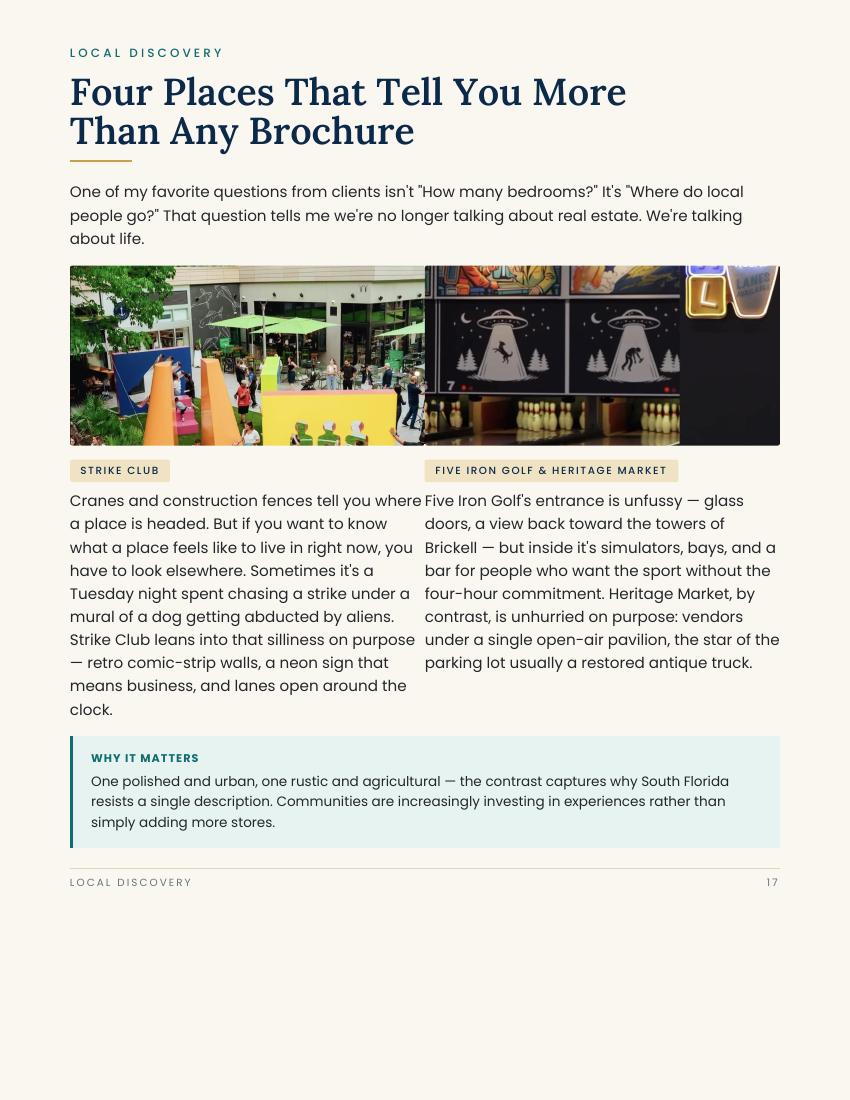
Cranes and construction fences tell you where a place is headed. But if you want to know what a place actually feels like to live in right now, you have to look somewhere else entirely. Not every reason to love a neighborhood shows up in a listing sheet. Sometimes it's a Tuesday night spent chasing a strike under a mural of a dog getting abducted by aliens.
Strike Club leans into that kind of silliness on purpose - retro comic-strip walls, a neon sign that means business ("LET THE GOOD TIMES ROLL"), and lanes open around the clock for anyone who takes their leisure seriously.
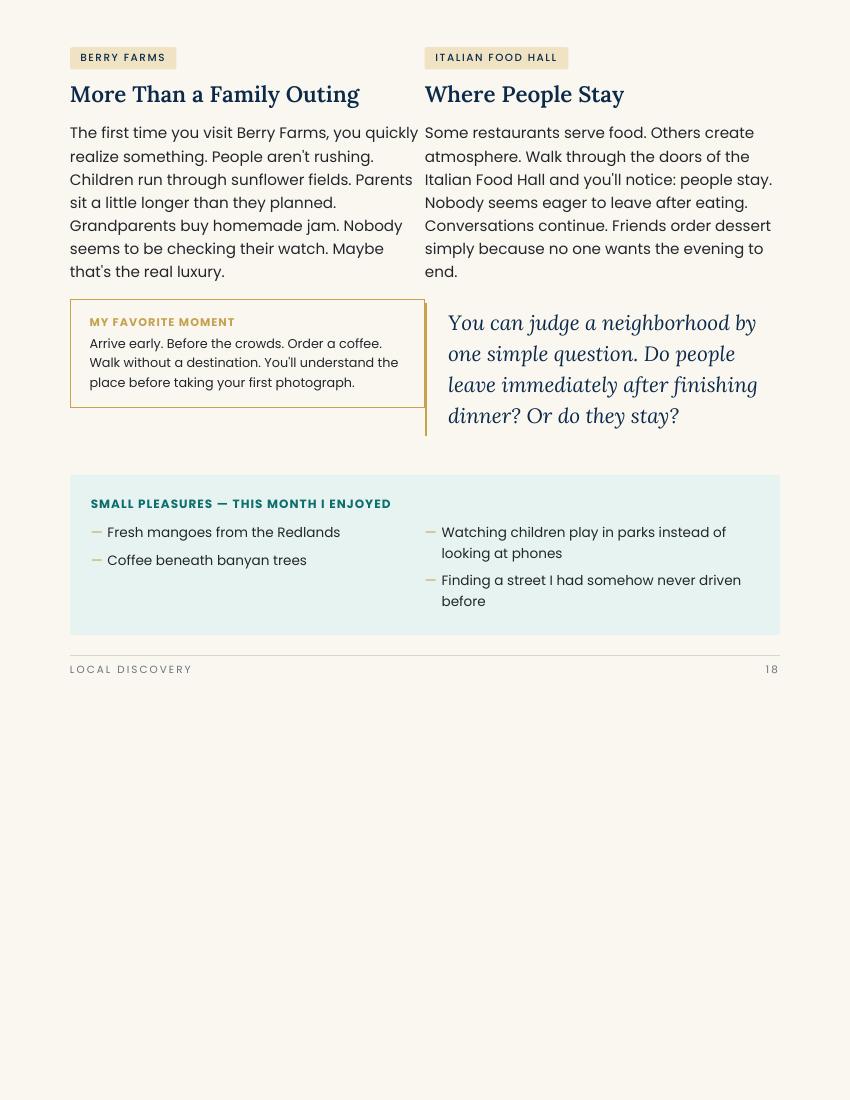
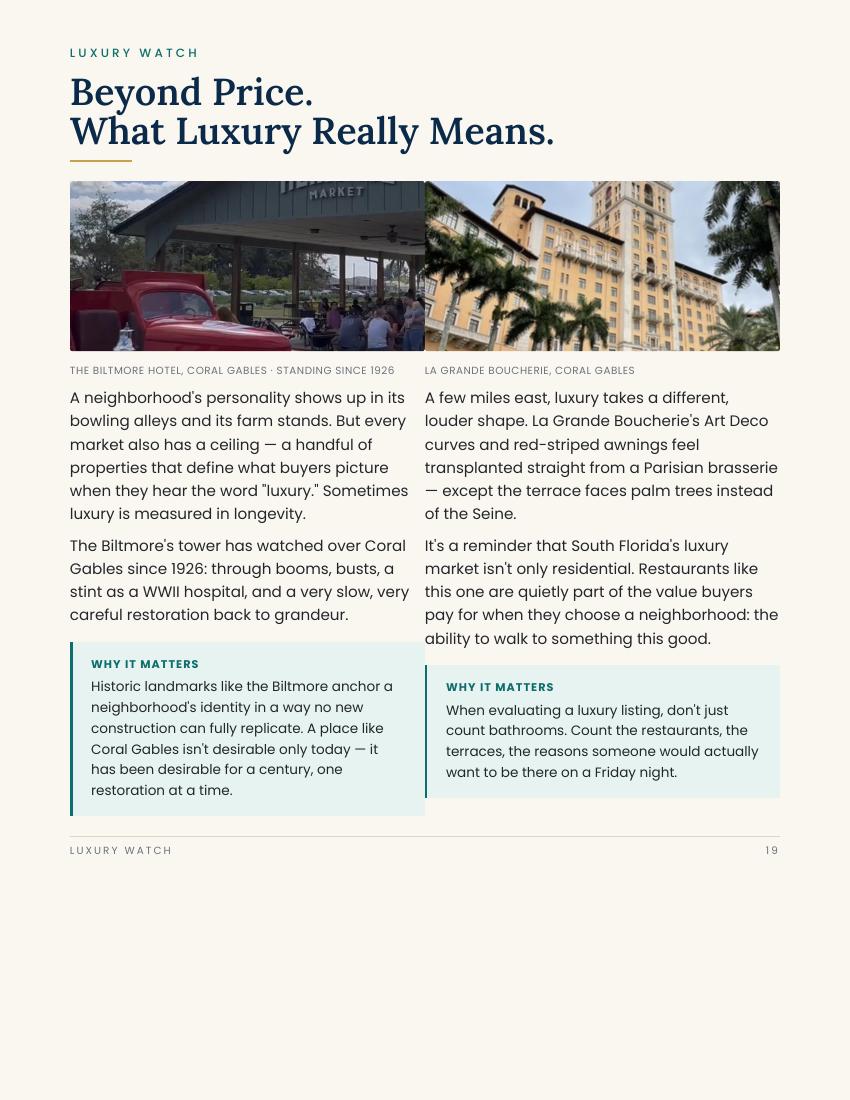
Five Iron Golf & Heritage Market. Five Iron Golf's entrance is unfussy - glass doors, a small badge logo, a view back toward the towers of Brickell - but inside it's simulators, bays, and a bar, built for people who want the sport without the four-hour commitment. Indoor golf simulators, full bar & lounge. Heritage Market, by contrast, is unhurried on purpose. Vendors set up under a single open-air pavilion; the star of the parking lot is usually a restored antique truck rather than anyone's SUV.
The short version: the contrast between these two spots - one polished and urban, one rustic and agricultural - captures why South Florida resists a single description. It's rarely just one thing.
Luxury Watch
A neighborhood's personality shows up in its bowling alleys and its farm stands. But every market also has a ceiling - a handful of properties that define what buyers picture when they hear the word "luxury" in the first place. Luxury in South Florida isn't only measured in square footage or finish level. Sometimes it's measured in longevity - in a building that has outlasted a century of trends and somehow still sets them.
The Biltmore's tower has watched over Coral Gables since 1926: through booms, busts, a stint as a WWII hospital, and a very slow, very careful restoration back to grandeur. It remains the tallest structure in the city by design, not accident - a piece of civic identity as much as architecture.
Where Luxury Eats.
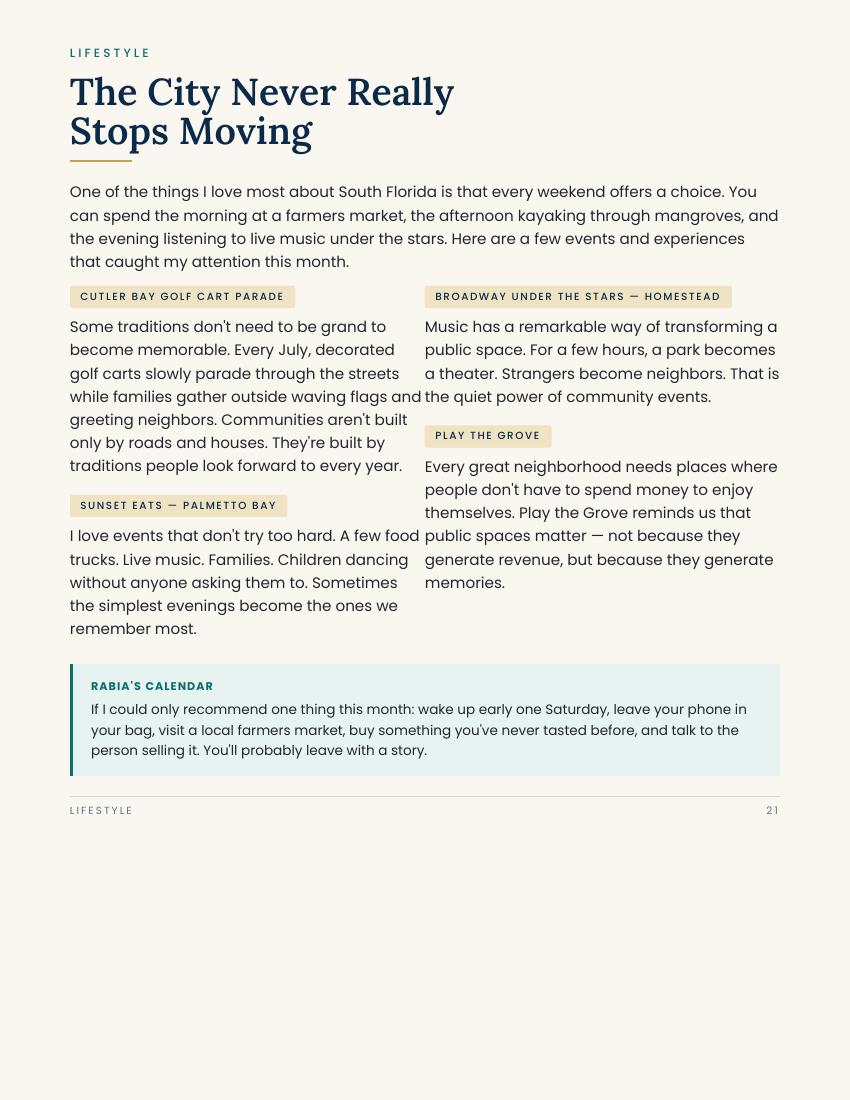
A few miles east, luxury takes a different, louder shape. La Grande Boucherie's Art Deco curves and red-striped awnings feel transplanted straight from a Parisian brasserie - except the terrace faces palm trees instead of the Seine. It's a reminder that South Florida's luxury market isn't only residential. Restaurants like this one are quietly part of the value proposition buyers are paying for when they choose a neighborhood: the ability to walk to something this good.
Put plainly: when evaluating a luxury listing, don't just count bathrooms. Count the restaurants, the terraces, the reasons someone would actually want to be there on a Friday night.
Every issue of this report starts the same way for me - standing in front of a construction fence, or a half-built town center, trying to figure out what it will actually feel like to live there once the dust settles. This month took me from a shuttered mall in Cutler Bay to a bowling alley with a taste for alien abduction murals, by way of a hotel that's been standing since 1926 and a mall that won't be standing much longer. That's South Florida in a nutshell: everything old is being reconsidered, and everything new is trying to earn a little history of its own.
Market Pulse: Before We Talk About Numbers...
Let's ask a better question. Why do housing markets change? Many people immediately think about mortgage rates. They're important. But they are only one piece of a much larger puzzle.
People move because of new jobs. Because their family grows. Because children leave home. Because companies relocate. Because neighborhoods improve. Because schools change. Because life changes. Markets simply reflect thousands of personal decisions happening at the same time.
That is why I encourage clients to look beyond headlines. The numbers explain what happened. They rarely explain why.
What It Means: The national market continues moving toward greater balance. Buyers have more options than they did a year ago. Sellers continue benefiting from historically strong home values, although realistic pricing has become increasingly important. After several years of exceptional market conditions, today's environment feels healthier. Negotiation has returned. Preparation matters. Patience matters. And understanding your local market matters more than ever.
South Florida: Why Miami Rarely Behaves Like the Rest of America
Every national report deserves one important reminder. Miami is not average. Neither is Broward. Nor Palm Beach.
South Florida continues attracting international buyers, entrepreneurs, retirees and families relocating from across the United States. That constant flow creates a market with its own rhythm. While some metropolitan areas experience significant slowdowns, South Florida often follows a different trajectory because demand comes from many different directions rather than a single local economy.
That doesn't mean prices always rise. It means our market deserves to be understood on its own terms.
Why This Matters: A national headline may influence emotions. Local knowledge influences decisions.
FIFA: Beyond Ninety Minutes
The FIFA World Cup will eventually leave. Its impact probably won't. Major international events have a remarkable way of accelerating investment. Transportation improves. Hotels expand. Restaurants open. Public spaces receive attention. Entire districts suddenly become known by millions of people who had never heard of them before.
For Miami, hosting the World Cup is not simply about football. It is another chapter in the city's long transformation into one of the world's truly international destinations. Long after the final whistle, visitors will continue arriving. Businesses will continue investing. And neighborhoods connected to that growth may continue benefiting for years.
Mortgage Rates: Looking Beyond the Percentage
Interest rates receive enormous attention. For good reason. They influence affordability. They affect monthly payments. They shape purchasing power. Yet one important thing rarely changes. Great neighborhoods remain great neighborhoods regardless of interest rates.
Markets adjust. Lenders introduce new programs. Buyers adapt. Life continues. That is why I always encourage people to consider the complete picture rather than focusing on a single percentage. Buying a home should never become a mathematical exercise alone. It is also a life decision.
Buyers: Don't spend all your energy trying to predict the perfect interest rate. Spend time understanding the communities where you hope to build your future.
Sellers: Today's buyers have choices again. Presentation. Pricing. Preparation. Those three elements matter more than ever. A beautifully presented home doesn't simply receive more visits. It creates confidence.
Coffee with Rabia
I have noticed something curious. Whenever I drive through South Florida without a destination, I discover places I had somehow missed dozens of times before. A tiny café hidden behind tropical plants. A mural at the end of a quiet street. A fruit stand that wasn't there last month. An old church surrounded by magnificent banyan trees.
Perhaps that is why I rarely believe people who say they've seen everything Miami has to offer. South Florida rewards curiosity. Sometimes the best discoveries happen because we took the wrong exit. Or ignored the GPS. Or simply decided to slow down for a few minutes.
Maybe that's true in real estate too. Sometimes we spend so much time searching for the perfect house that we forget to discover the neighborhood around it. And perhaps... that's where the real story begins.
Development Watch: Cities Are Like Living Organisms
Cities never stop growing. Sometimes the changes are obvious—a new skyline, a bridge, a residential tower. More often, they happen quietly. A wider road. A renovated park. A mixed-use project. A new school. A café where an empty storefront once stood.
Those small changes rarely make the evening news. Yet together they gradually redefine the way we experience a neighborhood. This month, four projects caught my attention—not because they are the largest, but because they tell us something about where South Florida is heading.
Contemporary + MedSquare — Cutler Bay.
Have you noticed how our definition of convenience has changed? Years ago, convenience meant living close to a shopping mall. Today, it increasingly means something different: living close to healthcare, restaurants, green spaces, fitness, daily services—without driving across half the county. That is the philosophy behind projects like Contemporary + MedSquare. Instead of separating where we live, work, shop and receive medical care, these developments try to bring everyday life closer together. It is less about building another apartment complex. It is about rethinking how communities function.
The reason: South Dade continues attracting residents looking for more space while remaining connected to the rest of Miami-Dade. Projects like this reflect that changing demand.
Link at SoMi.
South Miami has always felt slightly different from the rest of Miami. Perhaps because it never tried to become downtown. It remained human in scale. Walkable. Lined with independent businesses rather than endless chains. Projects like Link at SoMi continue that evolution. Growth without losing identity. Density without sacrificing character. That's much harder to achieve than simply building taller buildings.
Bigger picture: successful cities aren't measured only by how much they build. They're measured by how pleasant they remain after they've grown.
Homestead.
One of the questions I hear more frequently is: "Why is everyone suddenly talking about Homestead?" The answer isn't one project. It's many small pieces slowly coming together. Infrastructure improvements. Population growth. New businesses. Healthcare. Retail. Employment.
Every city reaches a moment when people stop asking, "Why would I move there?" and begin asking, "Why didn't I look there sooner?" Homestead may be approaching that moment.
If These Streets Could Talk: Old Cutler Road
Some roads simply connect two places. Old Cutler Road tells a story. Long before Miami became an international city, this route connected small settlements scattered across South Florida. Over time, magnificent banyan trees were planted along sections of the road, creating one of the most recognizable landscapes in Miami-Dade County.
Today, driving beneath that green canopy feels almost timeless. Perhaps that explains why photographers never seem to tire of it. Neither do I. Every season changes the light. Every storm changes the sky. Every drive reveals another detail I somehow missed before. Some places don't ask for attention. They quietly deserve it.
Why Here? Why Are So Many Projects Moving South?
People often assume developers simply follow available land. Land certainly matters. But it isn't the whole story. South Dade offers something increasingly valuable: room. Room for new schools. New parks. Modern infrastructure. Walkable developments. Healthcare. Retail.
As northern parts of Miami-Dade become more densely developed, southern communities naturally become the next chapter of the county's growth. Growth doesn't happen overnight. It arrives project by project. Intersection by intersection. Neighborhood by neighborhood.
Rabia's Observation: Whenever I hear someone describe South Dade as "far," I smile. Far from what? Sometimes what feels far today becomes tomorrow's center. Cities have been proving that for centuries.
Neighborhood Story: South Dade — Where Miami Slows Down... Without Standing Still
People often imagine South Dade as "the south." As if it were simply the last part of Miami. It isn't. It is almost another way of living.
The first thing many people notice is the space. The second is the trees. The third is something more difficult to describe. Life seems to breathe differently here. Perhaps because neighborhoods grew before every empty lot disappeared. Perhaps because agriculture never completely left. Perhaps because people still greet each other at the local bakery or the farmers market.
South Dade doesn't compete with Brickell. It doesn't need to. It offers something different. And in today's world, different has become valuable.
Cutler Bay.
Cutler Bay is one of those communities that quietly surprises people. Many first-time visitors expect another suburban neighborhood. Instead, they discover parks, marinas, schools, and neighborhoods that continue evolving without losing their family-oriented character.
Its history is also one of resilience. Hurricane Andrew changed this region forever. Entire communities rebuilt. Residents stayed. Businesses returned. New generations arrived. Today's Cutler Bay is the result of that determination. Growth here isn't replacing history. It is being built on top of it.
Palmetto Bay.
One detail has always fascinated me. It isn't called the City of Palmetto Bay. It proudly calls itself The Village of Palmetto Bay. That wasn't an accident. When residents voted to incorporate, they deliberately chose the word "Village" because it reflected the identity they wanted to preserve. Tree-lined streets. Parks. Excellent schools. Community life. Growth was welcome. But not at the expense of character. I find that rather refreshing.
Small detail, big meaning: names matter. Sometimes they tell us more about a community than statistics ever could.
The Redlands
If someone asked me where to understand Miami's past, I probably wouldn't send them downtown. I'd send them to the Redlands. There, South Florida tells a different story. Fields replace traffic. Fruit stands replace shopping centers. Mangoes. Avocados. Dragon fruit. Lychees.
Long before Miami became famous for finance and tourism, agriculture was one of the region's economic engines. The Redlands continue protecting that legacy. Driving through these roads reminds us that Miami wasn't built only with concrete. It was also built with soil.
Why This Matters: Agriculture isn't simply part of our history. It remains part of our economy. Protecting farmland while accommodating population growth will become one of South Florida's most important challenges over the coming decades. The future doesn't always replace the past. Sometimes the two learn to live together.
Rabia's Notebook.
One of my favorite Saturday mornings doesn't involve shopping. It begins with coffee... continues through the Redlands... and usually ends with my car carrying far more mangoes than I had planned to buy. I have accepted that this is simply who I am now. Some people collect shoes. Apparently... I collect tropical fruit.
Local Discovery: Four Places That Tell You More About South Florida Than Any Brochure
One of my favorite questions from clients isn't, "How many bedrooms?" It's this one: "Where do local people go?" That question tells me we're no longer talking about real estate. We're talking about life. Because sooner or later every homeowner discovers the same thing. The house matters. But the neighborhood becomes home.
This month I'd like to share four places that, in very different ways, capture the spirit of South Florida. Not because they're famous. Because they feel authentic.
Berry Farms — More Than a Family Outing.
The first time you visit Berry Farms, you quickly realize something. People aren't rushing. Children run through sunflower fields. Parents sit a little longer than they planned. Grandparents buy homemade jam. Nobody seems to be checking their watch. Maybe that's the real luxury. For generations, South Dade has been connected to the land. Berry Farms reminds us that this relationship still exists. It's not nostalgia. It's part of the region's identity.
My Favorite Moment: Arrive early. Before the crowds. Order a coffee. Walk without a destination. You'll understand the place before taking your first photograph.
Five Iron Golf.
When I first heard about an indoor golf venue, I thought, "That's interesting." Then I visited. It isn't really about golf. It's about bringing people together. Friends after work. Families. Beginners. Experienced golfers. Even people who've never touched a golf club. Places like this tell us something important. Communities are increasingly investing in experiences rather than simply adding more stores. People remember how a place made them feel. Not how many shops it contained.
Why It Matters: Lifestyle has become one of the strongest drivers of real estate. The best neighborhoods don't only offer homes. They offer reasons to leave the house.
Italian Food Hall.
Some restaurants serve food. Others create atmosphere. The Italian Food Hall belongs in the second category. Walk through the doors and you'll immediately notice something. People stay. Nobody seems eager to leave after eating. Conversations continue. Children wander from one counter to another. Friends order dessert simply because no one wants the evening to end. That's successful urban design. Not because of architecture alone. Because people enjoy spending time there.
Rabia's Observation: I've always believed you can judge a neighborhood by one simple question. Do people leave immediately after finishing dinner? Or do they stay? The answer tells you more than any market report.
Worth the Detour: Places I'd Recommend to a Friend
Not every recommendation has to be famous. Sometimes the best places are the ones locals quietly keep to themselves. This month, if you have a free Saturday... Take the long way home. Stop somewhere unexpected. Ignore your GPS once or twice. You may discover a neighborhood you've driven past for years without ever really seeing it. That has happened to me more than once. And I suspect it will happen again.
Small Pleasures this month: Fresh mangoes from the Redlands. Coffee beneath banyan trees. Watching children play in parks instead of looking at phones. Finding a street I had somehow never driven before. Sometimes happiness hides in remarkably ordinary places.
Luxury Watch: Rethinking Luxury
When we hear the word luxury, our imagination often jumps to waterfront mansions, private elevators and infinity pools. Those homes certainly exist. But over the years I've started defining luxury differently.
Luxury is silence. Luxury is natural light entering your kitchen at breakfast. Luxury is walking your dog beneath mature trees. Luxury is opening your windows in the evening and hearing birds instead of traffic. Luxury is time. Luxury is choosing where you want to spend it.
The most beautiful homes I've visited were not always the most expensive. They were simply the ones that felt right.
Architecture Speaks.
Every city develops its own architectural language. Coral Gables speaks with Mediterranean elegance. Coconut Grove whispers through tropical gardens. Miami Beach dances between Art Deco glamour and contemporary design. Brickell reaches toward the sky. The Redlands remain firmly connected to the earth. None is better. Each simply tells a different chapter of South Florida's story.
— Rabia Roig
Around South Florida: The City Never Really Stops Moving
One of the things I love most about South Florida is that every weekend offers a choice. You can spend the morning at a farmers market, the afternoon kayaking through mangroves, and the evening listening to live music under the stars. Life here isn't defined by one lifestyle. It's defined by possibilities. Here are a few events and experiences that caught my attention this month.
Cutler Bay Golf Cart Parade.
Some traditions don't need to be grand to become memorable. Every July, decorated golf carts slowly parade through the streets while families gather outside waving flags and greeting neighbors. It lasts only a short time. The memories last much longer. Communities aren't built only by roads and houses. They're built by traditions people look forward to every year.
Sunset Eats — Palmetto Bay.
I love events that don't try too hard. A few food trucks. Live music. Families. Children dancing without anyone asking them to. Sometimes the simplest evenings become the ones we remember most.
Broadway Under the Stars — Homestead.
Music has a remarkable way of transforming a public space. For a few hours, a park becomes a theater. Strangers become neighbors. People who had planned to leave after twenty minutes often stay until the last song. That is the quiet power of community events.
Play the Grove.
Every great neighborhood needs places where people don't have to spend money to enjoy themselves. Play the Grove reminds us that public spaces matter. Not because they generate revenue. Because they generate memories.
Rabia's Calendar: If I could only recommend one thing this month... Wake up early one Saturday. Leave your phone in your bag. Visit a local farmers market. Buy something you've never tasted before. Talk to the person selling it. You'll probably leave with a story.
Did You Know? Five Things You May Not Know About South Florida
- Miami-Dade County is one of the few places in the continental United States where tropical fruit grows commercially all year long.
- Biscayne Bay contains hundreds of small islands, many of which can only be reached by boat.
- Some banyan trees found throughout South Florida are now more than one hundred years old. Their branches eventually grow roots of their own, creating what almost feels like an entire forest from a single tree.
- Coral Gables was carefully planned long before most surrounding neighborhoods existed. Its wide boulevards, plazas and Mediterranean architecture were all part of George Merrick's original vision.
- Without Henry Flagler's railroad, modern Miami would almost certainly have developed much more slowly. Transportation has always shaped real estate. More than a century later... it still does.
Rabia's Notebook: The Wrong Turn
People often apologize when they get lost. I almost never do. Some of my favorite discoveries happened because I missed a turn. A hidden coffee shop. A small independent bookstore. A quiet park. An old church I never knew existed. Even neighborhoods.
Real estate has taught me that maps are useful. Curiosity is even more useful. Perhaps that's why I rarely drive the exact same way twice. South Florida has a habit of rewarding small detours. I suspect life does too.
Worth Reading
Every month I'd like to leave you with something beyond real estate. Because understanding a city isn't only about houses. It's about ideas. History. Architecture. People. This month...
Book Recommendation: The Death and Life of Great American Cities by Jane Jacobs. A classic that completely changed the way many people think about cities. After reading it, you'll never look at a neighborhood the same way again.
Podcast: Choose one episode this month about urban planning, architecture or the future of cities. You'll quickly discover that the best neighborhoods rarely happen by accident. They are designed. Protected. Improved.
Personal Recommendation: This month... Sit in a café you've never visited before. Not to work. Not to answer emails. Just to observe. Cities reveal themselves to people who slow down.
A Question for Next Month: What is your favorite hidden place in South Florida? I'd love to know. Perhaps it will appear in a future issue.
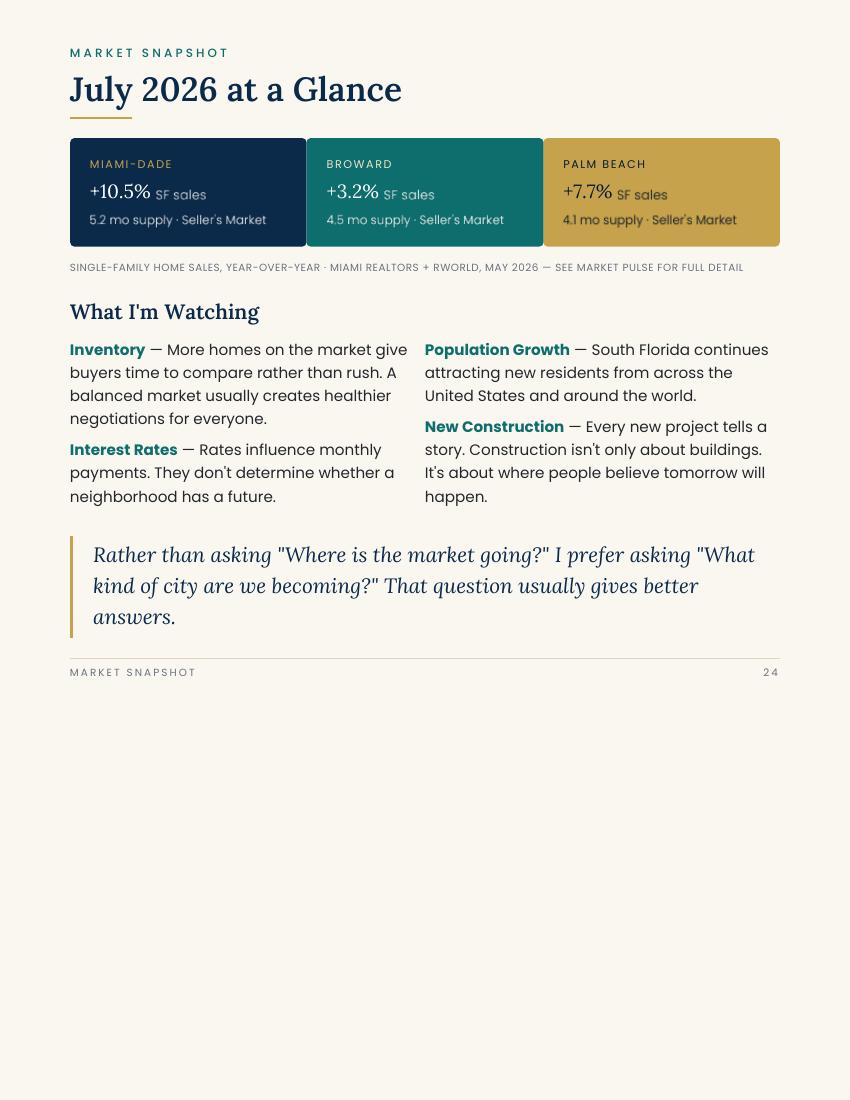
Market Snapshot: July 2026 at a Glance
What I'm Watching: Every month there are hundreds of statistics. Most of them will be forgotten by next month. Instead of trying to remember every number, I prefer watching a few long-term trends.
Inventory — More homes on the market give buyers time to compare rather than rush. A balanced market usually creates healthier negotiations for everyone.
Interest Rates — Rates influence monthly payments. They don't determine whether a neighborhood has a future. Communities continue evolving regardless of interest-rate cycles.
Population Growth — South Florida continues attracting new residents from across the United States and around the world. That steady demand remains one of our region's defining characteristics.
New Construction — Every new project tells a story. Sometimes it reflects confidence. Sometimes changing lifestyles. Sometimes population growth finally catching up with reality. Construction isn't only about buildings. It's about where people believe tomorrow will happen.
Looking Ahead: Rather than asking, "Where is the market going?" I prefer asking, "What kind of city are we becoming?" That question usually gives better answers.
One Last Thought
People often ask me why I enjoy real estate. The truth is... I don't think my favorite subject has ever been real estate. It's people. Real estate simply gives me an excuse to meet them. To hear their stories. To discover why one family dreams of a garden while another wants to live above a café. Why one person chooses the energy of Brickell while another feels instantly at home beneath the banyan trees of Palmetto Bay.
Every home search begins with a budget. It almost always ends with a feeling. And feelings are wonderfully difficult to measure. Perhaps that's why I never get tired of this profession. Every client teaches me something new. Every neighborhood has another story waiting to be discovered.
And every month... I'll bring one of those stories back here. Thank you for spending part of your day with me. I'll see you in August.
— Rabia
Coming Next Month — August 2026
- Why Coconut Grove Never Goes Out of Style — A walk through one of Miami's oldest and most beloved neighborhoods.
- The Psychology of Buying a Home — Why logic chooses the house... but emotion usually chooses the neighborhood.
- The Hidden History of Coral Rock — The stone beneath our feet that quietly built Miami.
- South Florida Book Club — A book that changes the way we look at cities.
- Weekend Escape — One destination less than an hour from Miami that deserves a place on your summer list.
Stay Curious. Because the more we understand where we live... the better decisions we make. Not only in real estate. In life.
Rabia Roig
Beachfront Realty
305-484-4367
onshorerealty@gmail.com
rabiaroig.mybeachfrontrealty.com
Categories
- All Blogs (22)
- Buying & Investment Guides (2)
- Coral gables (1)
- FLORIDA (5)
- foreign investment (1)
- Fort Lauderdale (1)
- Globalconflict (1)
- HISTORY (4)
- Homestead Florida (1)
- HUMOUR (1)
- INFO (5)
- investment (5)
- KEY BISCAYNE (1)
- Lifestyle & Culture (3)
- Lifestyle real estate (3)
- Market Intelligence (12)
- Miami (6)
- Miami-Dade Communities South Miami (2)
- Neighborhoods & Local Guides (10)
- REALESTATE (10)
- south Florida Neighborhoods (2)
- Things to do in Homestead (1)
- TOURISM (4)
Recent Posts

